


Measuring growth is essential for every Software-as-a-Service (SaaS) business. Whether you operate a small subscription-based startup or manage an established software company, understanding your financial performance helps you make better business decisions. However, tracking revenue alone does not provide a complete picture of business health. You also need to understand customer acquisition costs, customer lifetime value, recurring revenue, and customer churn.
This is where SaaS growth metrics become valuable. Metrics such as Monthly Recurring Revenue (MRR), Annual Recurring Revenue (ARR), Customer Acquisition Cost (CAC), Customer Lifetime Value (LTV), and churn rate help businesses evaluate profitability, customer retention, and long-term sustainability.
Using dedicated SaaS growth calculators and analytics tools makes it easier to monitor these metrics, identify weaknesses, and discover opportunities for improvement. Instead of relying on complicated spreadsheets and manual calculations, businesses can use these tools to make data-driven decisions.
In this guide, you will learn how to measure SaaS growth using MRR, ARR, CAC, LTV, and churn tools, understand their formulas, explore practical examples, and discover how these metrics work together to improve business performance.

What Is SaaS Growth Measurement?
SaaS growth measurement is the process of tracking key business indicators to understand how a subscription-based software company is performing over time. These indicators reveal whether revenue is increasing, customers are staying longer, and marketing investments are generating sustainable returns.
Unlike traditional businesses that may depend on one-time purchases, SaaS companies typically generate recurring revenue through monthly or annual subscriptions. This business model makes it important to measure both current performance and future revenue potential.
Effective SaaS growth measurement focuses on several areas:
- Revenue growth: How much recurring revenue the business generates.
- Customer acquisition: How much it costs to attract paying customers.
- Customer lifetime value: How much revenue or gross profit customers generate over their relationship with the business.
- Customer retention: How effectively the company keeps existing customers.
- Profitability: Whether customer revenue justifies acquisition and service costs.
By monitoring these areas together, SaaS businesses can make informed decisions about pricing, marketing, customer support, and product development.
1. Measure Monthly Recurring Revenue (MRR)
Monthly Recurring Revenue, commonly known as MRR, represents the predictable monthly revenue generated from active subscriptions. It is one of the most important SaaS growth metrics because it helps businesses understand their current revenue base.
MRR allows business owners to evaluate whether subscription revenue is increasing, remaining stable, or declining.
How to Calculate MRR
The basic formula is:
MRR = Number of Active Paying Customers × Average Monthly Revenue per Customer
For example, suppose a SaaS company has 250 paying customers, and each customer generates an average of $40 per month.
MRR = 250 × $40
MRR = $10,000
This means the business generates $10,000 in monthly recurring subscription revenue, assuming the subscriptions are active and the average monthly revenue is consistent.
For annual subscriptions, convert the recurring subscription value into a monthly equivalent when calculating MRR. For example, a $1,200 annual subscription contributes $100 in monthly recurring revenue.
How MRR Tools Help SaaS Businesses
An MRR calculator or subscription analytics tool can help you:
- Calculate monthly recurring revenue quickly.
- Track revenue growth from one month to another.
- Identify new revenue from recently acquired customers.
- Measure revenue lost through cancellations.
- Monitor expansion revenue from upgrades and additional subscriptions.
Many SaaS businesses also track new MRR, expansion MRR, contraction MRR, and churned MRR. These components explain why recurring revenue changes over time.
For example, a business might gain $2,000 in new MRR and $500 in expansion MRR but lose $700 through cancellations and downgrades. Understanding these movements provides a clearer view of growth than looking at the ending revenue figure alone.
2. Measure Annual Recurring Revenue (ARR)
Annual Recurring Revenue, or ARR, estimates the annualized value of recurring subscription revenue. It is particularly useful for SaaS companies with annual contracts, long-term subscriptions, or enterprise customers.
ARR helps businesses evaluate their revenue scale, plan budgets, communicate performance to stakeholders, and establish long-term growth targets.
How to Calculate ARR
For a business with stable monthly recurring revenue, the standard simplified formula is:
ARR = MRR × 12
Suppose your SaaS company generates $25,000 in MRR.
ARR = $25,000 × 12
ARR = $300,000
This indicates an annualized recurring revenue run rate of $300,000.
However, ARR is not necessarily the amount of revenue the business will actually collect during the next 12 months. It assumes the recurring revenue base remains consistent. It should generally exclude one-time setup fees, consulting income, and other non-recurring revenue.
Why ARR Tracking Tools Matter
An ARR calculator helps SaaS companies estimate annualized revenue and compare performance over time. These tools can support:
- Annual revenue forecasting.
- Subscription growth analysis.
- Budget planning.
- Revenue target monitoring.
- Investor and management reporting.
For example, if your ARR increases from $300,000 to $360,000, your ARR growth rate is:
ARR Growth Rate = ((New ARR − Previous ARR) ÷ Previous ARR) × 100
The calculation becomes (($360,000 − $300,000) ÷ $300,000) × 100, resulting in 20% ARR growth.
This increase indicates that your recurring revenue run rate has improved by 20%, although it does not automatically mean that your profit has grown by the same percentage.
3. Measure Customer Acquisition Cost (CAC)
Customer Acquisition Cost, or CAC, measures how much a business spends to acquire a new paying customer. It is a critical metric for understanding marketing efficiency and sales performance.
SaaS companies often invest in paid advertising, search engine optimization, content marketing, sales teams, and referral programs. CAC helps determine whether these investments are generating customers at a sustainable cost.
How to Calculate CAC
The basic formula is:
CAC = Total Customer Acquisition Costs ÷ Number of New Customers Acquired
Suppose your company spends $12,000 on sales and marketing during a month and acquires 120 new paying customers.
CAC = $12,000 ÷ 120
CAC = $100 per customer
This means the business spends an average of $100 to acquire each new customer.
For a more accurate calculation, include the relevant costs associated with acquisition, such as advertising, sales salaries, marketing software, agency fees, and campaign expenses. Use a consistent time period and make sure the costs correspond to the customers acquired during that period.
How CAC Calculators Improve Marketing Decisions
A CAC calculator helps you evaluate whether your acquisition strategy is efficient. It can help you:
- Compare acquisition costs across marketing channels.
- Evaluate paid advertising campaigns.
- Measure the financial impact of SEO and content marketing.
- Identify expensive customer acquisition processes.
- Set realistic marketing budgets.
For example, if customers acquired through organic search cost less than customers acquired through paid advertising, your company may benefit from investing more in high-performing SEO content. However, organic acquisition is not free; content creation, technical SEO, and employee time should be considered when calculating fully loaded costs.
CAC should also be evaluated alongside customer quality, retention, and lifetime value. A low-cost customer is not necessarily valuable if that customer cancels after one month.

4. Measure Customer Lifetime Value (LTV)
Customer Lifetime Value, commonly abbreviated as LTV or CLV, estimates the value a business receives from a customer throughout the customer’s relationship with the company.
For SaaS businesses, LTV helps determine whether the revenue or gross profit generated by customers justifies the cost of acquiring and serving them.
How to Calculate LTV
A simplified subscription business formula is:
LTV = Average Revenue per Customer per Month × Gross Margin Percentage ÷ Monthly Customer Churn Rate
Suppose a SaaS company has the following metrics:
- Average monthly revenue per customer: $100
- Gross margin: 80%
- Monthly customer churn rate: 4%
LTV = ($100 × 0.80) ÷ 0.04
LTV = $2,000
Under this simplified model, the estimated gross-profit lifetime value is $2,000 per customer.
This formula assumes relatively stable revenue, gross margin, and churn. It is a useful approximation rather than a precise prediction of every customer’s future behavior.
How LTV Calculators Support Growth
An LTV calculator can help SaaS businesses:
- Estimate the long-term value of customers.
- Compare customer segments.
- Evaluate subscription pricing.
- Assess retention initiatives.
- Determine sustainable acquisition spending.
For example, customers on a premium subscription plan may generate higher monthly revenue and remain customers longer than users on a basic plan. Segmenting LTV by subscription type can reveal which customers contribute the most value.
Businesses should also distinguish revenue-based LTV from gross-profit-based LTV. Gross-profit-based LTV accounts for the direct costs of delivering the service and is often more useful when comparing customer value with acquisition cost.
5. Measure Customer Churn Rate
Customer churn rate measures the percentage of customers who stop using a subscription service during a specific period. It is one of the most important SaaS retention metrics because recurring revenue depends on customers continuing their subscriptions.
High churn can reduce recurring revenue, increase replacement acquisition costs, and weaken long-term business performance.
How to Calculate Customer Churn
The standard customer churn formula is:
Customer Churn Rate = (Customers Lost During the Period ÷ Customers at the Beginning of the Period) × 100
For example, suppose your company starts a month with 800 customers and loses 32 customers during that month.
Churn Rate = (32 ÷ 800) × 100
Customer Churn Rate = 4%
This means the company lost 4% of its starting customer base during the month.
When calculating customer churn, use the number of customers at the beginning of the period as the denominator. New customers acquired during that period should not be included in the starting customer count.
Revenue Churn vs. Customer Churn
Customer churn and revenue churn measure different aspects of retention.
Customer churn measures the percentage of customers who cancel their subscriptions.
Revenue churn measures the recurring revenue lost from cancellations and, depending on the definition used, downgrades.
A company might lose several low-paying customers while retaining its largest accounts. In this situation, customer churn could be relatively high while revenue churn remains lower. Conversely, losing one major enterprise customer can significantly affect revenue even when customer churn is low.
Net revenue retention (NRR) provides another useful perspective by considering expansion revenue, contraction, and churn from existing customers. An NRR above 100% means revenue from the existing customer cohort has grown over the measurement period, excluding new customer acquisition.
How Churn Calculators Help
A churn rate calculator helps businesses:
- Monitor customer retention.
- Identify periods of increased cancellations.
- Evaluate customer satisfaction initiatives.
- Compare churn across subscription plans.
- Measure the impact of onboarding and customer support.
For example, if churn decreases from 5% to 3% per month, the company has improved its retention performance. However, the business should also investigate why churn changed, rather than assuming that every improvement will continue automatically.
6. Understand the LTV-to-CAC Ratio
Tracking LTV and CAC separately is useful, but comparing them provides a stronger indication of acquisition efficiency.
The LTV-to-CAC ratio compares estimated customer lifetime value with the cost of acquiring that customer.
LTV-to-CAC Formula
LTV-to-CAC Ratio = Customer Lifetime Value ÷ Customer Acquisition Cost
Suppose your business has an estimated LTV of $2,000 and a CAC of $500.
LTV-to-CAC = $2,000 ÷ $500
LTV-to-CAC Ratio = 4:1
This means the estimated lifetime value is four times the acquisition cost.
A ratio around 3:1 is often used as a rough SaaS benchmark, but the appropriate target varies by company, industry, growth stage, margins, and cash flow. A higher ratio is not automatically better if the business is underinvesting in profitable growth.
The ratio should be calculated using consistent customer segments and compatible measurement methods. For instance, comparing gross-profit-based LTV with fully loaded CAC is generally more informative than comparing revenue-based LTV with only advertising spend.
7. How to Use SaaS Growth Calculators Together
Using separate calculators provides useful information, but combining the results gives you a more complete picture of business performance.
Follow these steps to build a practical measurement process:
Step 1: Collect Accurate Subscription Data
Gather information about active customers, subscription prices, upgrades, downgrades, cancellations, and billing periods. Ensure that monthly and annual subscriptions are converted consistently when calculating recurring revenue.
Step 2: Calculate MRR and ARR
Use an MRR calculator to estimate monthly recurring revenue and an ARR calculator to annualize the recurring revenue base. Track both metrics regularly to understand revenue trends.
Step 3: Calculate CAC
Combine relevant sales and marketing expenses with the number of new paying customers acquired during the same period. If possible, calculate CAC by channel to identify efficient acquisition strategies.
Step 4: Estimate LTV
Use average customer revenue, gross margin, and churn data to estimate customer lifetime value. For businesses with substantial customer variation, calculate LTV by customer segment rather than relying on a single company-wide average.
Step 5: Track Churn and Retention
Use a churn calculator to monitor cancellations and compare monthly trends. Investigate whether customers leave because of pricing, poor onboarding, missing features, limited product adoption, or better competitor offerings.
Step 6: Compare LTV With CAC
Calculate the LTV-to-CAC ratio to assess whether the estimated customer value justifies acquisition spending. Review payback period as well, because a business can have strong estimated lifetime economics but still face cash flow challenges if acquisition costs take too long to recover.
Step 7: Review Trends and Take Action
Create a monthly dashboard containing MRR, ARR, CAC, LTV, churn, and customer acquisition numbers. Review changes over time and use the findings to improve pricing, product experience, customer support, and marketing allocation.
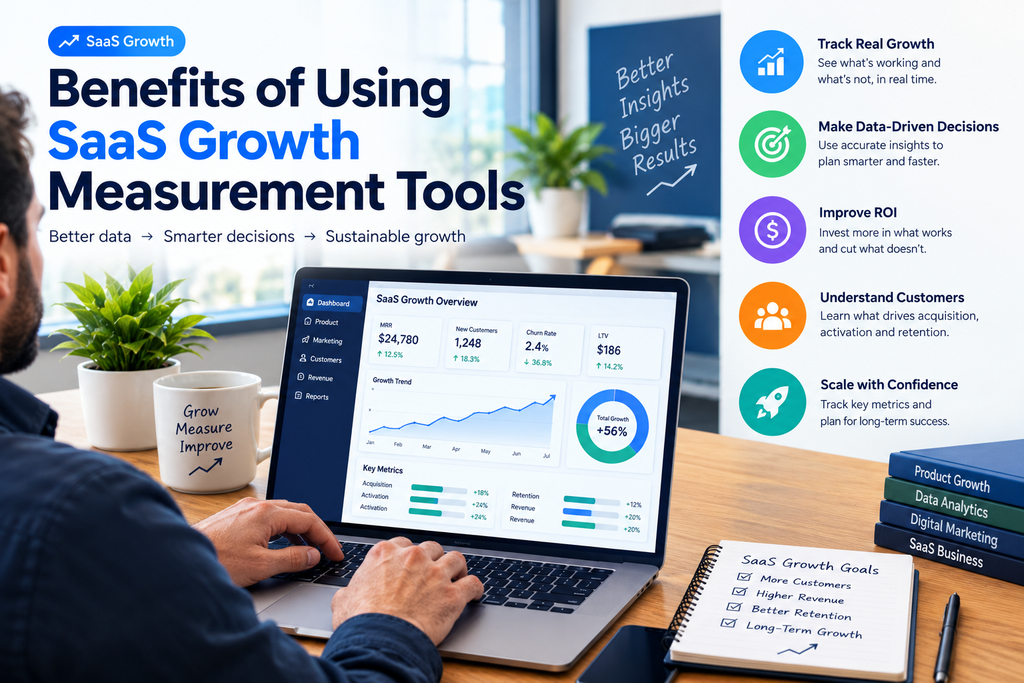
8. Benefits of Using SaaS Growth Measurement Tools
SaaS growth calculators and analytics platforms offer several practical benefits for subscription businesses.
Faster calculations: Automated tools reduce repetitive spreadsheet work and help standardize formulas.
Better decision-making: Reliable metrics provide evidence for pricing changes, marketing investments, and retention initiatives.
Improved financial planning: MRR and ARR help businesses evaluate their recurring revenue base and establish realistic targets.
More efficient marketing: CAC tracking helps identify acquisition channels that deliver customers at sustainable costs.
Stronger customer retention: Churn analysis helps teams investigate cancellations and prioritize improvements that encourage customers to stay.
Clearer growth opportunities: Combining revenue, acquisition, and retention metrics helps identify whether the main challenge is attracting customers, retaining them, or generating additional value from existing accounts.
However, calculators are only as accurate as the data entered. Businesses should validate their formulas, use consistent definitions, and reconcile important revenue figures with their billing and accounting systems.
9. Common Mistakes to Avoid When Measuring SaaS Growth
Even useful SaaS metrics can lead to poor decisions if they are calculated incorrectly or interpreted without context.
- Confusing revenue with profit: High MRR does not necessarily mean a business is profitable.
- Treating ARR as guaranteed revenue: ARR is an annualized run rate, not a promise of future collections.
- Underestimating CAC: Ignoring sales salaries, agency fees, or other relevant acquisition expenses can make marketing appear more efficient than it really is.
- Using inconsistent churn definitions: Customer churn and revenue churn should be reported separately.
- Ignoring gross margin: Revenue-based LTV can overstate the value of customers when service delivery costs are significant.
- Relying on one month of data: Short-term changes may not represent a reliable long-term trend.
- Ignoring customer segments: Different subscription plans and acquisition channels may have very different economics.
Avoiding these mistakes helps create a more dependable SaaS growth measurement system.
Frequently Asked Questions (FAQs)
1. What are the most important SaaS growth metrics?
The most important metrics include MRR, ARR, CAC, LTV, customer churn, revenue churn, and net revenue retention. Together, they help measure recurring revenue, acquisition efficiency, customer value, and retention performance.
2. How often should SaaS companies calculate MRR and ARR?
Most SaaS businesses review MRR monthly and monitor ARR alongside it. Companies with high transaction volumes or rapid growth may also monitor revenue movements weekly or daily.
3. What is a good LTV-to-CAC ratio for SaaS?
A ratio of approximately 3:1 is commonly used as a rough benchmark. However, the ideal ratio depends on gross margins, customer retention, growth targets, and the time required to recover acquisition costs.
4. Why is customer churn important for SaaS businesses?
Churn directly affects the customer base and recurring revenue. High churn can make growth more expensive because companies must continually acquire new customers to replace those who leave.
5. Can SaaS growth calculators improve profitability?
Yes. Calculators can help identify inefficient acquisition spending, weak retention, and unfavorable customer economics. Profitability improves only when the business uses these insights to make effective operational and financial decisions.
6. What is the difference between MRR and ARR?
MRR represents recurring revenue on a monthly basis, while ARR represents its annualized value. For a stable subscription base, ARR is commonly calculated as MRR multiplied by 12.
Conclusion
Measuring SaaS growth requires more than tracking sales or counting new subscribers. Businesses need a clear understanding of recurring revenue, customer acquisition costs, lifetime value, and customer churn to evaluate whether their growth is sustainable.
MRR and ARR reveal the scale of recurring revenue, CAC measures acquisition efficiency, LTV estimates long-term customer value, and churn highlights retention challenges. The LTV-to-CAC ratio connects customer value with acquisition spending, helping businesses evaluate their overall growth economics.
By using reliable SaaS growth calculators and reviewing these metrics consistently, businesses can make better decisions about marketing, pricing, customer experience, and long-term planning. The most effective approach is to combine accurate data, consistent formulas, and regular performance reviews.
Ultimately, sustainable SaaS growth comes from attracting the right customers, delivering ongoing value, retaining subscribers, and building a recurring revenue model that supports long-term business success.






Leave a Reply