

Customer retention is one of the most important factors behind the long-term success of a Software as a Service (SaaS) business. While attracting new customers helps a company grow, retaining existing customers creates stable recurring revenue and supports sustainable business development. However, many SaaS companies struggle to understand how many customers they lose over a specific period and how those losses affect their revenue. This is where a Churn Rate Calculator becomes a valuable tool.
A churn rate calculator helps SaaS businesses measure the percentage of customers who stop using their products or cancel their subscriptions during a particular period. By calculating customer churn, businesses can identify retention problems, evaluate customer satisfaction, and make informed decisions to improve their services.
Whether you operate a small SaaS startup or manage an established subscription-based business, understanding churn rate can help you develop stronger customer relationships and improve recurring revenue. In this guide, we will explain what a churn rate calculator is, how it works, its benefits, the different types of churn, and practical strategies SaaS companies can use to reduce customer loss.
What Is a Churn Rate Calculator?
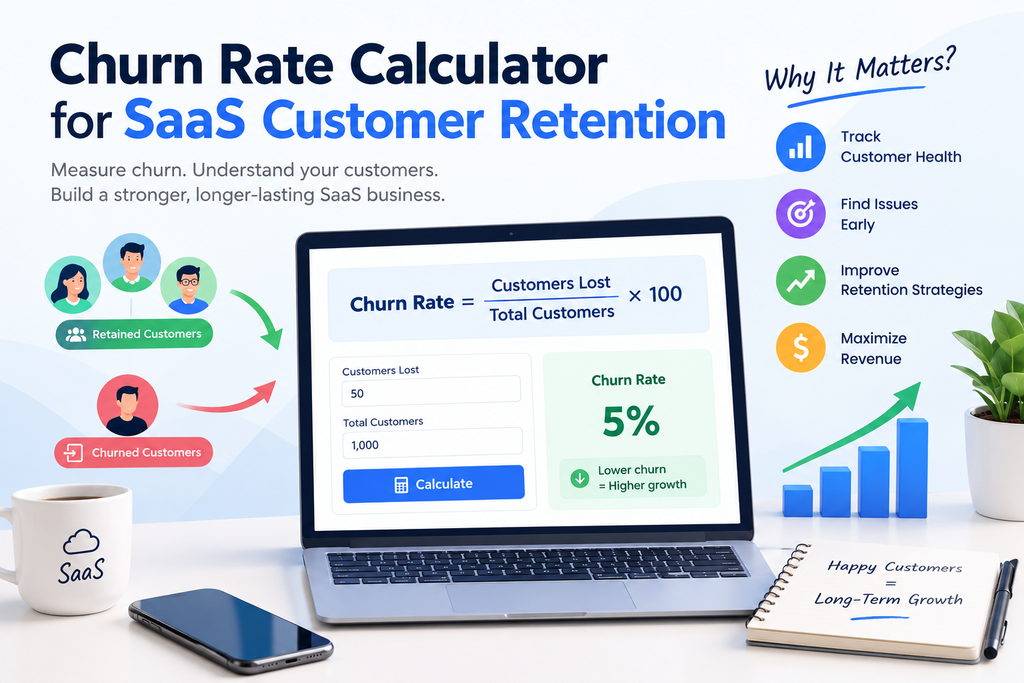
A Churn Rate Calculator is an online tool or mathematical calculation that measures the percentage of customers who leave a business during a defined period. In SaaS businesses, customer churn generally occurs when users cancel subscriptions, discontinue paid plans, or stop renewing their contracts.
For example, imagine a SaaS company starts a month with 1,000 paying customers. During that month, 50 customers cancel their subscriptions. The company’s monthly customer churn rate is 5%.
Calculating this percentage manually is relatively simple, but a dedicated churn rate calculator makes the process faster and more convenient. Businesses can enter their starting customer count and the number of customers lost to calculate their churn rate without repeatedly performing the formula themselves.
A churn rate calculator can also support monthly, quarterly, and annual performance tracking. Depending on its features, it may help businesses compare different periods, analyze customer retention trends, and understand how customer losses influence subscription revenue.
For SaaS companies that depend on monthly recurring revenue (MRR) or annual recurring revenue (ARR), monitoring churn is particularly important. Even if a company consistently acquires new customers, a high churn rate can limit growth and make revenue less predictable.
Why Is a Churn Rate Calculator Important for SaaS Businesses?
Customer acquisition is only one part of building a successful SaaS business. Companies must also provide enough value to encourage customers to continue paying for their products. A churn rate calculator helps businesses measure how effectively they retain their customers.
Here are some of the main reasons SaaS companies use a churn rate calculator.
1. Measure Customer Retention Performance
A churn rate calculator allows businesses to determine the percentage of customers lost during a specific period. This measurement provides a clearer understanding of whether customer retention is improving or declining.
For example, if a company’s monthly churn rate decreases from 7% to 4%, it may indicate that recent improvements in customer support, product usability, or onboarding are helping customers stay longer.
However, businesses should examine customer segments and other relevant data before attributing the improvement to a particular change.
2. Identify Potential Revenue Losses
Every canceled subscription can affect recurring revenue. A SaaS company losing a large number of paying customers may experience declining MRR, especially if replacement customers are not acquired quickly enough.
A churn rate calculator helps identify customer losses, while a separate revenue churn calculation can measure the financial impact of cancellations and downgrades.
This information helps businesses understand whether their current retention performance supports their revenue goals.
3. Improve Business Planning
SaaS companies need reliable information to plan marketing budgets, product development, staffing, and future growth. Churn rate provides one useful indicator of how consistently a business retains customers.
When a company understands its historical churn patterns, it can make more informed assumptions about future customer retention. These assumptions can be incorporated into financial forecasts and customer acquisition plans.
4. Evaluate Customer Satisfaction
A rising churn rate may indicate that customers are experiencing problems with pricing, product features, technical performance, or customer support.
Although churn does not directly measure customer satisfaction, it can highlight areas that require investigation.
By combining churn data with customer surveys, cancellation reasons, support tickets, and product usage analytics, SaaS businesses can identify opportunities to improve the customer experience.
5. Support Sustainable SaaS Growth
A business that acquires customers efficiently but loses them quickly may struggle to grow profitably. Lower churn can help a SaaS company preserve its existing customer base and build a stronger foundation for recurring revenue.
A churn rate calculator makes it easier to monitor this important metric and evaluate retention initiatives over time.
How Does a Churn Rate Calculator Work?
A churn rate calculator uses a straightforward mathematical formula to determine the percentage of customers lost during a specific period.
The standard customer churn formula is:
\[ \text{Customer Churn Rate} = \frac{\text{Customers Lost During Period}} {\text{Customers at Start of Period}} \times 100 \]
To use this formula, you need two primary inputs:
- Starting customers: The number of active customers at the beginning of the selected period.
- Customers lost: The number of customers who left during that same period.
The calculator divides the number of lost customers by the starting customer count and multiplies the result by 100.
Example of Churn Rate Calculation
Suppose a SaaS company begins a month with 2,000 customers and loses 100 customers before the month ends.
The calculation is:
\[ \frac{100}{2000}\times100=5\% \]
The company’s monthly customer churn rate is 5%.
This means the company lost 5% of its starting customer base during that month.
Churn Rate Calculator Example
Enter your customer figures to calculate customer churn.Customers at the beginningCustomers lost during the period
Calculated customer churn rate
5%
Customers remaining from the starting group: 1,900
Reset example
This example assumes that the starting customer count and customer losses are measured consistently. New customers acquired during the month should not be included in the starting customer count when calculating conventional customer churn.
Different Types of Churn Rate in SaaS
Not all churn metrics measure the same thing. SaaS companies should understand the different types of churn to avoid overlooking important retention problems.
1. Customer Churn Rate
Customer churn rate measures the percentage of customers who stop using a service during a specific period.
For example, if a SaaS business starts a quarter with 800 customers and loses 40, its quarterly customer churn rate is:
\[ \frac{40}{800}\times100=5\% \]
Customer churn is useful for understanding changes in the size of a customer base. However, it does not indicate how much revenue those customers contributed.
2. Revenue Churn Rate
Revenue churn rate measures the percentage of recurring revenue lost from existing customers during a specific period.
A common measure is gross monthly recurring revenue churn, calculated as:
\[ \text{Gross Revenue Churn} = \frac{\text{MRR Lost from Existing Customers}} {\text{Starting MRR}}\times100 \]
Revenue lost may include subscription cancellations and downgrades, depending on the company’s chosen definition.
For example, a company begins the month with $50,000 in MRR and loses $2,500 in recurring revenue from cancellations and downgrades.
Its gross revenue churn rate is 5%.
This metric helps SaaS companies understand the financial impact of customer losses, particularly when subscription values vary significantly.
3. Gross Revenue Churn vs. Net Revenue Churn
Gross revenue churn measures recurring revenue lost from existing customers without offsetting those losses with expansion revenue.
Net revenue churn includes expansion revenue from existing customers, such as upgrades or additional seats. A common calculation is:
\[ \text{Net Revenue Churn} = \frac{\text{Starting MRR}-\text{Ending MRR from the Same Cohort}} {\text{Starting MRR}}\times100 \]
For this calculation, ending MRR from the same cohort includes the effects of cancellations, downgrades, and expansion, but excludes new-customer revenue.
Net revenue churn can be negative when expansion revenue exceeds revenue lost from existing customers. This is often described as negative net revenue churn.
4. Subscription Churn Rate
Subscription churn measures canceled subscriptions rather than necessarily counting unique customers. It can be useful when a business allows one customer to maintain multiple subscriptions or accounts.
Companies should distinguish subscription cancellations from customer departures to ensure that their reports reflect the intended metric.
5. Voluntary and Involuntary Churn
Voluntary churn happens when customers intentionally cancel their subscriptions, perhaps because they no longer need the service or are dissatisfied with the product.
Involuntary churn happens when a subscription ends because of payment failures, expired cards, billing issues, or unsuccessful payment retries.
These two types of churn often require different solutions. Voluntary churn may call for better product value and customer engagement, while involuntary churn may be reduced through improved billing systems and payment recovery processes.
How Can SaaS Companies Use a Churn Rate Calculator?
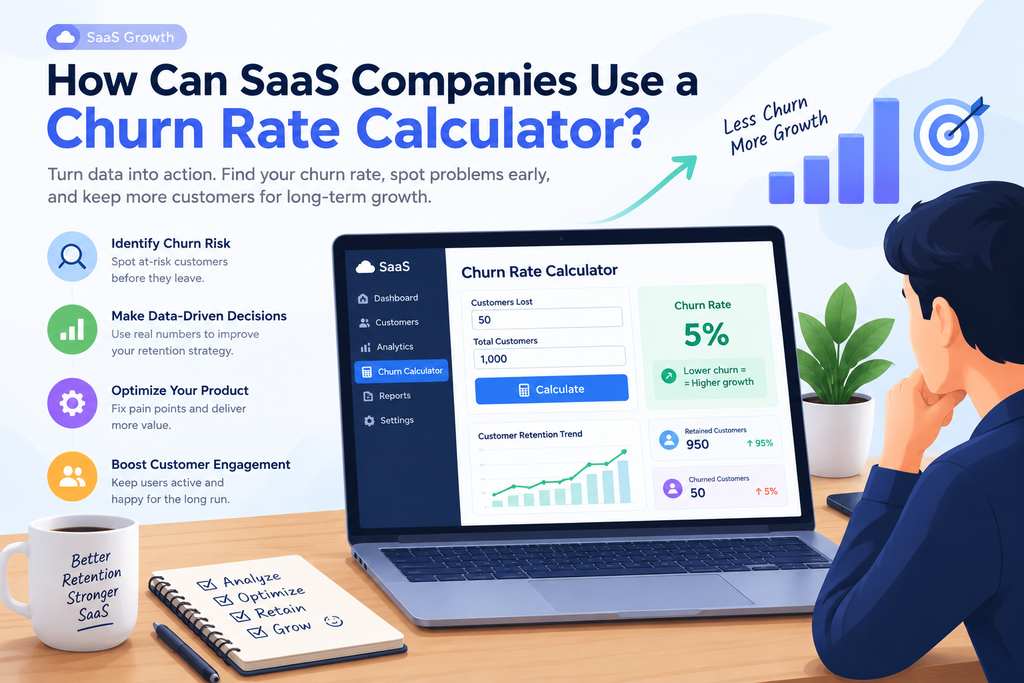
A churn rate calculator is most valuable when its results guide practical business decisions. SaaS companies can use churn data in several ways.
1. Monitor Monthly Customer Losses
Businesses can calculate their churn rate every month and compare the result with previous periods.
A consistent reporting schedule helps identify unusual increases in cancellations and makes it easier to evaluate whether retention performance is improving.
For example, a SaaS company may discover that churn increases after customers complete their first month. This pattern could suggest that users are struggling to understand the product’s value or are not receiving enough support during onboarding.
The company can investigate the issue and introduce improvements.
2. Improve Customer Onboarding
The first few days or weeks of a customer’s experience can strongly influence their decision to continue using a product.
SaaS businesses can use churn analysis to identify when customers are most likely to leave and improve the onboarding experience accordingly.
Useful strategies include:
- Creating guided product tours.
- Providing tutorials and educational resources.
- Sending helpful onboarding emails.
- Offering setup assistance to new customers.
- Helping users reach their first meaningful result quickly.
A smoother onboarding process can help customers understand the product and recognize its value sooner.
3. Identify High-Churn Customer Segments
An overall churn rate may hide important differences between customer groups.
For example, customers on a low-cost monthly plan may cancel more frequently than customers on annual subscriptions. Similarly, customers from one acquisition channel may retain better than customers from another.
SaaS companies can calculate churn separately by:
- Subscription plan.
- Customer acquisition channel.
- Customer industry.
- Business size.
- Subscription age.
- Product usage level.
Segmented analysis helps businesses identify where retention problems are concentrated and choose more relevant solutions.
4. Optimize Subscription Pricing
Pricing can influence customer retention, particularly when users do not believe a product provides sufficient value for its cost.
A churn rate calculator can help businesses monitor cancellations before and after pricing changes. However, companies should also consider customer feedback, conversion rates, plan upgrades, and revenue changes.
If customers frequently cancel after moving to a more expensive plan, the company may need to communicate the additional benefits more clearly or reconsider how its pricing tiers are structured.
Pricing decisions should be based on multiple indicators rather than churn alone.
5. Improve Customer Support
Slow responses, unresolved technical issues, and confusing documentation can contribute to customer frustration.
SaaS companies can compare churn data with support ticket volume, resolution time, and customer feedback to determine whether support problems may be associated with cancellations.
Possible improvements include faster response times, more useful help documentation, proactive communication, and dedicated assistance for high-value customers.
6. Forecast Recurring Revenue
Churn rate is an important input in SaaS financial forecasting.
Businesses can use historical customer churn assumptions to estimate how much of their existing customer base may remain in future periods. Revenue forecasts should also account for new customer acquisition, upgrades, downgrades, pricing changes, and seasonality where relevant.
For example, a company expecting substantial customer losses may need to increase its retention investment or adjust its customer acquisition targets.
However, churn forecasts are estimates, not guarantees. Historical rates may change as the product, customer mix, and market conditions evolve.
7. Measure Retention Campaign Performance
Retention campaigns may include customer success calls, educational emails, loyalty incentives, product training, and personalized offers.
A churn rate calculator allows a business to track changes in customer losses during and after these campaigns.
To evaluate effectiveness more reliably, companies should compare similar customer groups or use controlled experiments where practical. This helps distinguish the effect of a campaign from unrelated changes in churn.
What Is a Good Churn Rate for a SaaS Business?
There is no single churn rate that is ideal for every SaaS company. An acceptable rate depends on factors such as target customers, pricing, subscription length, product category, business maturity, and contract structure.
For example, a SaaS company serving small businesses on monthly subscriptions may experience different churn patterns from an enterprise software provider with annual contracts.
The table below illustrates hypothetical monthly customer churn rates and their possible interpretations. These are examples, not universal industry benchmarks.
| Monthly customer churn | Possible interpretation |
|---|---|
| Below 2% | May indicate strong retention for some subscription businesses |
| 2%–5% | May be manageable, depending on the business model |
| 5%–8% | May warrant closer investigation into retention issues |
| Above 8% | May indicate significant customer retention challenges |
These ranges should not be treated as fixed standards. A company should compare its results with relevant industry benchmarks, historical performance, and its own business goals.
Annual contracts also require careful interpretation. A business with long contract terms may show low monthly cancellations but still face substantial renewal churn when contracts expire.
Ultimately, a good churn rate is one that supports sustainable growth, customer satisfaction, and the company’s financial objectives.
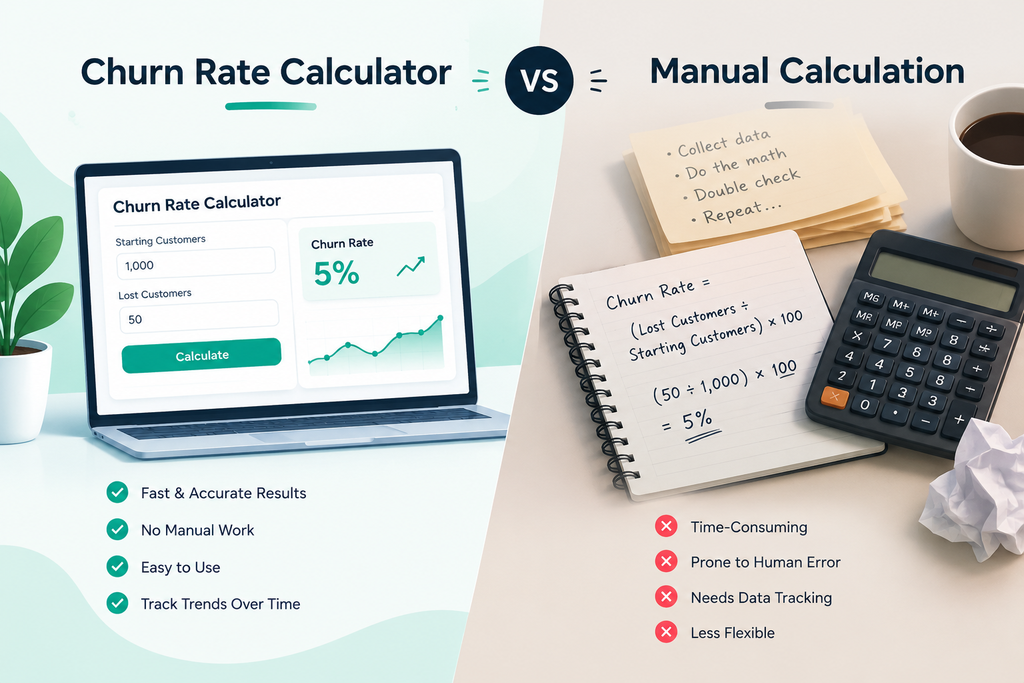
Churn Rate Calculator vs. Manual Calculation
Both a churn rate calculator and a manual formula can produce the same result when the inputs and definitions are consistent. The main difference is convenience and the ability to handle repeated calculations.
| Feature | Churn Rate Calculator | Manual Calculation |
|---|---|---|
| Calculation speed | Usually instant | Requires manual work |
| Formula handling | Automated | User performs the formula |
| Risk of arithmetic errors | Lower for basic calculations | Higher if calculations are repeated incorrectly |
| Multiple periods | Easier with suitable tools | Requires repeated calculations |
| Advanced reporting | May be available | Requires additional analysis |
| Data entry | Usually manual or integrated | Usually manual |
For startups with a small customer base, a spreadsheet or simple calculator may be sufficient. Larger SaaS businesses may benefit from analytics platforms that integrate billing data, customer accounts, subscription events, and revenue metrics.
A calculator does not automatically guarantee accurate results. Companies must still enter correct data and use consistent definitions for customer loss and reporting periods.
Common Mistakes to Avoid When Calculating Churn Rate
Even a straightforward churn calculation can produce misleading results when businesses use inconsistent data or interpret the metric incorrectly.
1. Including New Customers in the Starting Count
Conventional customer churn uses the number of active customers at the beginning of the period as the denominator.
Adding new customers acquired during the period to that denominator can distort the calculation.
2. Mixing Different Time Periods
Monthly, quarterly, and annual churn rates are not directly interchangeable. Businesses should clearly label each reporting period and compare equivalent time frames.
They should also avoid simply multiplying monthly churn by 12 to estimate annual churn without considering compounding or changes in customer behavior.
3. Confusing Customer Churn with Revenue Churn
Losing ten low-paying customers may have a different financial impact from losing ten enterprise customers.
Customer churn and revenue churn answer different questions, so SaaS businesses should monitor both when possible.
4. Ignoring Customer Segments
An overall churn rate can hide problems affecting specific plans, industries, or customer groups. Segmenting the data can reveal patterns that would otherwise remain unnoticed.
5. Treating Correlation as Causation
If churn decreases after a new feature launches, the feature may have helped, but other factors could also explain the change.
Businesses should combine churn analysis with customer feedback, product analytics, and controlled comparisons where feasible.
Best Practices for Reducing SaaS Customer Churn
Calculating churn is only the first step. SaaS companies must use their findings to improve customer experiences and encourage long-term retention.
Deliver consistent product value. Customers are more likely to remain subscribed when a product reliably solves their problems. Regular product improvements should focus on genuine user needs.
Collect customer feedback. Exit surveys, interviews, and feedback forms can help businesses understand why customers cancel. Keep surveys concise and make it easy for customers to explain their concerns.
Monitor product engagement. Declining usage, abandoned onboarding, and reduced activity may indicate that customers are struggling to receive value. Use these signals to offer relevant help without overwhelming users.
Provide proactive support. Address recurring technical problems, improve documentation, and help customers resolve difficulties before frustration leads to cancellation.
Improve billing recovery. Payment reminders, secure payment-method updates, and appropriate retry processes can help recover failed subscriptions and reduce involuntary churn.
Offer relevant subscription options. Flexible plans, appropriate downgrade options, and clear pricing can help customers find a subscription that matches their needs and budget.
Track retention metrics consistently. Review customer churn, gross revenue churn, net revenue retention, renewal rates, and customer lifetime value together. No single metric provides a complete picture of business health.
How Does Churn Rate Affect Customer Lifetime Value?
Customer lifetime value (LTV or CLV) estimates the total value a business expects to receive from a customer over the duration of the relationship.
For subscription businesses, churn can have a significant influence on customer lifetime value because customers who remain longer may generate recurring revenue for a longer period.
A simplified SaaS estimate sometimes used for recurring-revenue businesses is:
\[ \text{Customer Lifetime in Months}\approx \frac{1}{\text{Monthly Churn Rate}} \]
In this formula, churn must be expressed as a decimal rather than a percentage.
For example, if monthly customer churn is 5%, the decimal is 0.05:
\[ \frac{1}{0.05}=20\text{ months} \]
This simplified model estimates an average customer lifetime of approximately 20 months under a constant-churn assumption.
It is not a guarantee of actual customer lifespan. Real customer behavior may vary, and the formula is less suitable when churn changes significantly across customer cohorts or over time.
Customer lifetime value can also be estimated using average revenue per account and gross margin, but the appropriate formula depends on the business model and the quality of the available data.
By monitoring churn and customer lifetime value together, SaaS companies can better understand retention economics and evaluate how much they can reasonably invest in customer acquisition.
Conclusion
A Churn Rate Calculator is a useful tool for SaaS companies that want to understand customer losses, measure retention performance, and make more informed business decisions. By calculating the percentage of customers who cancel their subscriptions during a specific period, businesses can identify potential problems and develop strategies to improve customer loyalty.
Beyond basic calculations, churn analysis can support revenue forecasting, customer segmentation, onboarding improvements, pricing decisions, and customer success initiatives. Tracking both customer churn and revenue churn provides a more complete understanding of how cancellations affect a subscription business.
However, calculating churn is only the beginning. SaaS companies should investigate why customers leave, monitor retention trends consistently, and use the findings to improve their products and services.
With accurate data and a proactive retention strategy, businesses can use a churn rate calculator to make better decisions, protect recurring revenue, and build a stronger foundation for sustainable SaaS growth.
Frequently Asked Questions (FAQs)
What is a churn rate calculator used for?
A churn rate calculator measures the percentage of customers who stop using a service during a specified period. SaaS companies use it to monitor retention, identify customer losses, and evaluate changes in subscription performance.
How do you calculate customer churn rate?
Divide the number of customers lost during a period by the number of active customers at the beginning of that period, then multiply the result by 100.
Is a high churn rate bad for SaaS companies?
A high churn rate can make recurring revenue less predictable and increase the need to acquire replacement customers. Its significance depends on the business model, customer segments, and industry benchmarks.
What is the difference between customer churn and revenue churn?
Customer churn measures the percentage of customers lost, while revenue churn measures the recurring revenue lost from existing customers. Both metrics help SaaS companies understand different aspects of retention performance.
Can a churn rate calculator help reduce churn?
A calculator does not directly prevent cancellations, but it helps businesses identify retention trends and evaluate whether changes to onboarding, customer support, billing, or product features are associated with improved retention.
How often should SaaS companies calculate churn rate?
Many SaaS companies monitor churn monthly. Businesses with large customer bases or frequent subscription changes may also track churn weekly or analyze it by customer cohort, subscription plan, or acquisition channel.
Why is churn rate important for SaaS growth?
Churn rate helps companies understand whether they are retaining customers effectively. Lower customer losses can support more predictable recurring revenue and improve the long-term economics of customer acquisition.






Leave a Reply