
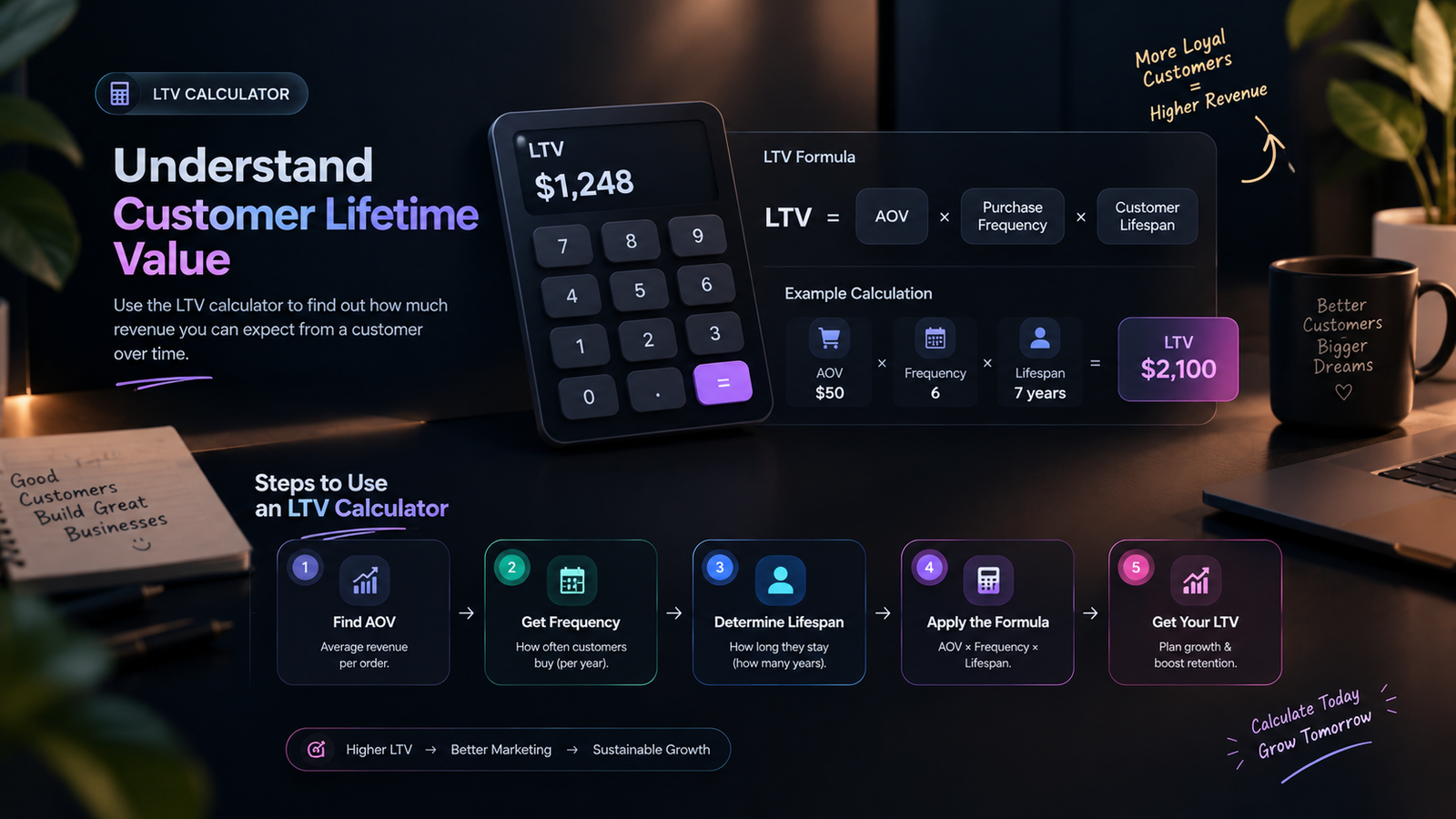

Understanding customer value is essential for building a profitable and sustainable business. Whether you operate a Software as a Service (SaaS) company, an e-commerce store, a subscription platform, or a digital service business, knowing how much revenue a customer generates over time can help you make smarter financial decisions. This is where an LTV calculator becomes an important business tool.
An LTV calculator helps businesses estimate Customer Lifetime Value (LTV), which represents the total value a customer is expected to generate throughout their relationship with a company. By calculating customer lifetime value, businesses can evaluate customer profitability, improve retention strategies, optimize marketing investments, and make more informed decisions about customer acquisition.
For subscription-based businesses, customer relationships often extend over months or years. A customer may initially purchase a monthly subscription but continue paying for several years if the product consistently meets their needs. Understanding this long-term relationship allows businesses to evaluate more than the value of a single transaction.
Customer lifetime value is especially important when compared with Customer Acquisition Cost (CAC), which measures how much a business spends to acquire a new customer. If a company spends too much to acquire customers who generate little value, its growth may become financially unsustainable. On the other hand, customers who remain loyal, make repeat purchases, and generate strong profit margins can contribute significantly to long-term business success.
In this comprehensive guide, you will learn what an LTV calculator is, how customer lifetime value works, which formulas businesses can use, how to calculate LTV, and why this metric matters for SaaS growth, marketing performance, customer retention, and profitability.
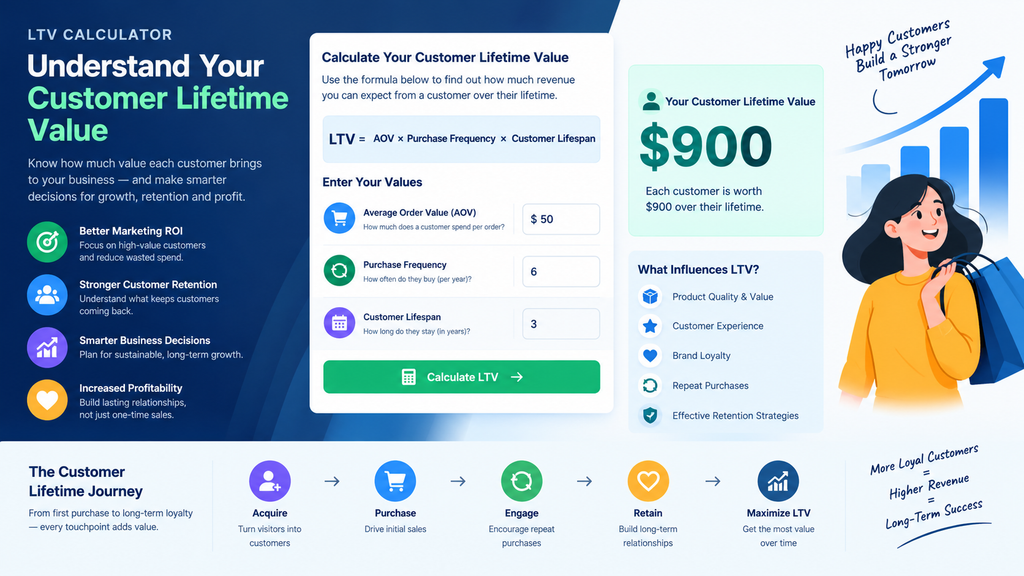
What Is an LTV Calculator?
An LTV calculator is a financial analysis tool that helps businesses estimate the lifetime value of their customers. LTV stands for Lifetime Value, while CLV or CLTV stands for Customer Lifetime Value. These terms are often used interchangeably to describe the value a customer generates during their relationship with a business.
An LTV calculator uses business information such as average purchase value, purchase frequency, customer lifespan, average revenue per user, gross margin, and customer retention to estimate customer value. The exact inputs depend on the business model and the formula being used.
For example, an e-commerce business may calculate customer lifetime value using average order value, the number of purchases made annually, and the expected customer relationship length. A SaaS company may use average monthly recurring revenue per customer, gross margin, and monthly customer churn.
The purpose of an LTV calculator is to turn customer and revenue data into useful business insights. It helps business owners understand which customers are valuable, how retention affects long-term revenue, and how much they may reasonably invest in acquiring new customers.
LTV calculators are useful for SaaS startups, online retailers, subscription businesses, marketing agencies, membership platforms, digital service providers, and established companies that want to improve customer profitability.
What Is Customer Lifetime Value (LTV)?
Customer Lifetime Value is the estimated total value a customer generates throughout their relationship with a business. Depending on the calculation method, LTV may represent total revenue or, more usefully for profitability analysis, the gross profit generated by that customer.
For example, imagine a customer pays $50 per month for a software subscription and remains subscribed for 24 months. The customer generates $1,200 in subscription revenue before accounting for discounts, refunds, service delivery costs, and other expenses.
However, $1,200 in revenue does not necessarily mean the company earns $1,200 in profit. If the business has a gross margin of 80%, the estimated gross profit contribution is $960, assuming the margin remains consistent throughout the relationship.
This distinction is important because revenue-based LTV can overstate the economic value of a customer when product delivery and service costs are significant.
Customer lifetime value helps businesses understand the long-term financial contribution of their customers rather than focusing only on immediate sales. It also highlights the importance of customer satisfaction, repeat purchases, subscription renewals, and effective retention strategies.
How Does an LTV Calculator Work?
An LTV calculator works by combining relevant customer, revenue, and retention data to estimate the value generated during a customer relationship.
The process generally involves the following steps.
Step 1: Identify Average Revenue per Customer
The first step is determining how much revenue a customer typically generates during a selected period.
For a SaaS company, this may be monthly recurring revenue per customer. For an e-commerce store, it may be average revenue per order or average monthly spending.
For example, if a subscription business generates $20,000 in monthly recurring revenue from 400 customers, its average monthly revenue per customer is $50.
Step 2: Determine Customer Retention or Lifespan
The second step is estimating how long customers remain active or how frequently they make repeat purchases.
Subscription businesses often use churn rate to estimate customer lifespan. A business with a lower churn rate generally retains customers for longer, assuming other conditions remain stable.
For businesses without subscriptions, customer lifespan may be estimated using historical purchasing behavior and repeat-purchase patterns.
Step 3: Include Gross Margin When Appropriate
Gross margin measures the proportion of revenue remaining after direct costs associated with delivering a product or service.
Including gross margin allows businesses to estimate customer lifetime gross profit rather than revenue alone.
For example, if monthly revenue per customer is $50 and gross margin is 80%, monthly gross profit per customer is $40.
Step 4: Calculate Customer Lifetime Value
Once the relevant inputs are available, the calculator applies the appropriate formula.
For a simplified subscription business with a stable monthly churn rate, a commonly used gross-profit-based formula is:
LTV = Average Monthly Revenue per Customer × Gross Margin ÷ Monthly Customer Churn Rate
If average monthly revenue is $50, gross margin is 80%, and monthly customer churn is 4%, the estimated LTV is:
LTV = $50 × 0.80 ÷ 0.04
LTV = $1,000.
This simplified model estimates $1,000 in customer lifetime gross profit contribution under the assumption that revenue, gross margin, and churn remain stable.
Actual results may vary due to customer expansion, downgrades, changing churn rates, discounts, and other business conditions.
Customer Lifetime Value Formula Explained
There are several ways to calculate customer lifetime value. The most suitable formula depends on the type of business, the data available, and whether the objective is to measure revenue or profitability.
1. Basic Customer Lifetime Value Formula
A simple formula for businesses with repeat purchases is:
LTV = Average Purchase Value × Purchase Frequency × Customer Lifespan
Suppose an online store has an average order value of $40, customers make five purchases per year, and the average customer relationship lasts three years.
LTV = $40 × 5 × 3
LTV = $600.
This means the estimated customer generates $600 in revenue throughout the relationship, before accounting for costs.
2. SaaS Customer Lifetime Value Formula
Subscription businesses can use the following simplified formula:
LTV = ARPU × Gross Margin ÷ Customer Churn Rate
ARPU stands for Average Revenue per User or customer. Gross margin should be expressed as a decimal, while churn must be expressed as a rate for the same time period as ARPU.
For example, if monthly ARPU is $100, gross margin is 75%, and monthly churn is 5%, then:
LTV = $100 × 0.75 ÷ 0.05
LTV = $1,500.
This represents estimated customer lifetime gross profit under the simplified model.
3. Revenue-Based LTV Formula
Businesses may also calculate revenue-based lifetime value without applying gross margin.
Revenue LTV = Average Revenue per Customer per Period × Estimated Customer Lifespan in Periods
If a customer generates $60 per month and remains active for an estimated 18 months, revenue LTV is $1,080.
Revenue LTV is useful for revenue forecasting, but it should not be confused with customer profitability.
Why Does Customer Lifetime Value Matter?
Customer lifetime value is an important metric because it helps businesses understand how customer relationships contribute to long-term financial performance.
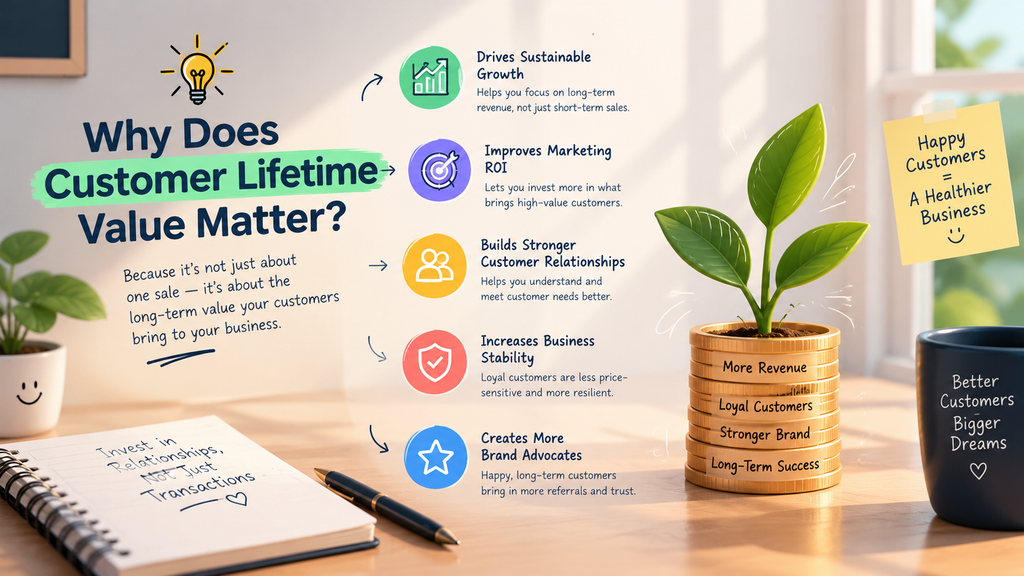
1. Helps Improve Customer Acquisition Decisions
Businesses spend money on advertising, content marketing, search engine optimization, sales teams, and other acquisition activities to attract new customers.
LTV helps determine how much customer value is available to support these expenses. When combined with Customer Acquisition Cost, it provides a clearer picture of whether acquisition strategies are economically sustainable.
For example, acquiring a customer for $100 may be attractive if the customer generates $900 in lifetime gross profit. However, the business must also account for operating expenses, overhead, cash flow, and other costs before determining overall profitability.
2. Supports Better Marketing Budget Allocation
Not all marketing channels attract customers with the same long-term value.
A paid advertising campaign may generate many customers who cancel quickly, while an organic search campaign may attract customers who remain subscribed for longer. Evaluating LTV by acquisition channel can help businesses identify which sources deliver stronger long-term customer value.
Companies should use reliable attribution methods and sufficient data before reallocating significant marketing budgets based on these comparisons.
3. Improves Customer Retention Strategies
Retaining customers can increase the total value generated by each customer relationship.
When businesses improve onboarding, provide responsive support, address product problems, and deliver ongoing value, customers may be more likely to renew subscriptions or make repeat purchases.
LTV analysis helps businesses evaluate the potential financial benefits of retention programs and prioritize initiatives that support long-term customer relationships.
4. Helps Measure Business Profitability
Revenue growth alone does not guarantee profitability. A company may generate substantial sales while spending too much to acquire customers or deliver its products.
Gross-profit-based LTV helps businesses understand the economic contribution generated by customer relationships before acquisition costs and other operating expenses.
5. Supports Long-Term Financial Planning
Customer lifetime value can help businesses estimate future revenue, evaluate subscription models, forecast customer economics, and assess the potential impact of changes in churn or pricing.
For SaaS companies, these insights can support planning for product investment, marketing expenditure, hiring, and expansion into new markets.
What Is a Good LTV-to-CAC Ratio?
The LTV-to-CAC ratio compares Customer Lifetime Value with Customer Acquisition Cost. It helps businesses assess whether the value generated by a customer justifies the cost of acquiring that customer.
LTV-to-CAC Ratio = Customer Lifetime Value ÷ Customer Acquisition Cost
Suppose a SaaS company estimates that each customer generates $900 in lifetime gross profit and spends $300 to acquire a customer.
LTV-to-CAC Ratio = $900 ÷ $300
LTV-to-CAC Ratio = 3:1.
This means the estimated customer lifetime gross profit is three times the acquisition cost.
A ratio near 3:1 is often used as an initial reference point in SaaS discussions, but it is not a universal rule. Appropriate targets depend on business maturity, customer retention, sales cycles, margins, market conditions, and cash flow.
A very low ratio may indicate that acquisition costs are too high relative to customer value. A very high ratio may indicate efficient acquisition, but it could also suggest that the business has opportunities to invest more in sustainable growth.
Businesses should calculate LTV and CAC using consistent definitions and avoid comparing revenue-based LTV with fully loaded acquisition costs without clearly accounting for the difference.
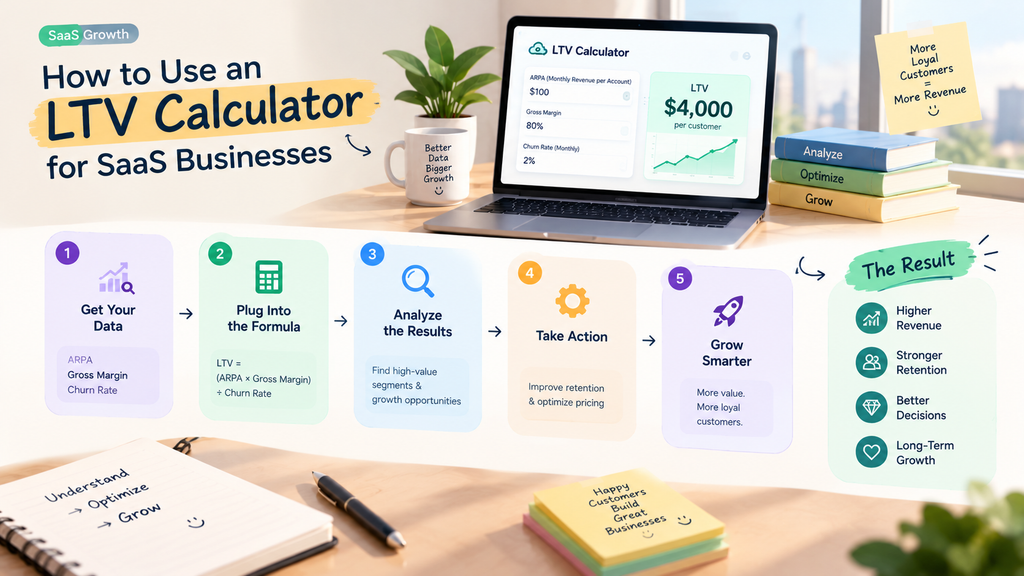
How to Use an LTV Calculator for SaaS Businesses
SaaS businesses can use an LTV calculator to understand the relationship between recurring revenue, gross margin, and customer retention.
Start by collecting average monthly recurring revenue per customer, gross margin, and customer churn for a consistent reporting period. Enter these figures into the calculator and review the estimated lifetime value.
Next, compare the LTV result with CAC and calculate the LTV-to-CAC ratio. This comparison helps evaluate whether customer acquisition costs are reasonable relative to the expected gross profit contribution.
Businesses can also test different scenarios. For example, they can estimate how LTV might change if monthly churn falls from 5% to 4%, average revenue per customer increases, or gross margin improves.
These calculations are useful for strategic planning, but the results are estimates rather than guaranteed financial outcomes. Companies with rapidly changing customer behavior should consider cohort analysis or more advanced predictive models.
How to Increase Customer Lifetime Value
Increasing LTV involves improving the value customers receive from a business and strengthening the financial performance of customer relationships.
Improve Customer Onboarding
A smooth onboarding process helps customers understand the product and reach meaningful results sooner. SaaS businesses can provide setup guides, tutorials, product walkthroughs, and responsive assistance to help new users get started successfully.
Reduce Customer Churn
Customer churn reduces the length of subscription relationships and can lower estimated lifetime value. Businesses can monitor cancellation reasons, identify customers at risk of leaving, improve product reliability, and address recurring service problems.
Encourage Repeat Purchases
E-commerce and service businesses can improve repeat purchasing through relevant recommendations, loyalty programs, personalized offers, and consistent customer experiences.
Offer Relevant Upgrades
SaaS companies may increase average revenue per customer by offering additional features, higher subscription tiers, or suitable add-on services. Upgrades should address genuine customer needs rather than simply increase prices without delivering value.
Improve Product Quality and Customer Support
Reliable products and helpful support encourage customer trust. Businesses that consistently solve customer problems may improve retention, increase referrals, and strengthen long-term customer relationships.
Common Mistakes to Avoid When Calculating LTV
Although customer lifetime value is a useful metric, incorrect assumptions can produce misleading results.
One common mistake is confusing total revenue with gross profit. Revenue-based LTV does not account for the direct costs of delivering products or services, so it may overstate the economic value of a customer.
Another mistake is using an inaccurate churn rate or mixing monthly revenue with annual churn. Revenue and churn must use consistent time periods for the calculation to be meaningful.
Businesses may also rely on short-term data to predict customer relationships that last several years. New businesses, rapidly growing SaaS companies, and organizations with changing pricing structures should treat LTV estimates cautiously.
Ignoring differences between customer segments can also distort results. Customers acquired through different channels or subscription plans may have different spending patterns, retention rates, and service costs.
To improve accuracy, businesses should use reliable historical data, clearly document assumptions, include gross margin where appropriate, analyze customer cohorts, and regularly update their calculations.
Frequently Asked Questions About LTV Calculators
1. What is an LTV calculator?
An LTV calculator is a tool that estimates the total revenue or gross profit a customer generates throughout their relationship with a business. It uses information such as average spending, purchase frequency, customer lifespan, gross margin, or churn rate.
2. How do you calculate customer lifetime value?
For a simple repeat-purchase business, multiply average purchase value by purchase frequency and customer lifespan. For a subscription business with stable monthly churn, a common gross-profit-based formula is monthly revenue per customer multiplied by gross margin and divided by monthly churn rate.
3. What is the difference between LTV and CLV?
LTV, CLV, and CLTV are commonly used abbreviations for Customer Lifetime Value. Their precise meaning depends on the calculation method, particularly whether the metric measures revenue or gross profit.
4. Why is customer lifetime value important for SaaS?
LTV helps SaaS companies evaluate customer economics, compare lifetime value with acquisition cost, improve retention strategies, and make informed decisions about marketing investments and sustainable growth.
5. What is a good customer lifetime value?
There is no single ideal LTV for every business. A suitable value depends on subscription pricing, customer retention, gross margin, acquisition cost, and the company’s financial objectives. Businesses should evaluate LTV alongside CAC and other financial metrics.
6. What is the difference between LTV and CAC?
LTV estimates the value generated by a customer over time, while CAC measures the cost of acquiring that customer. Comparing the two helps businesses evaluate whether customer acquisition is economically sustainable.
7. Can an LTV calculator help increase profits?
Yes. An LTV calculator can highlight the financial impact of retention, repeat purchases, customer spending, and gross margin. Businesses can use these insights to improve customer experiences, allocate marketing budgets, and optimize customer acquisition strategies.
8. How often should businesses calculate LTV?
Many businesses review LTV monthly or quarterly, depending on their data and business model. Subscription companies may monitor churn and recurring revenue monthly, while businesses with longer customer relationships may also analyze annual trends and customer cohorts.
Conclusion
An LTV calculator is a valuable tool for understanding the long-term financial value of customer relationships. By estimating customer lifetime value, businesses can evaluate acquisition strategies, improve retention, allocate marketing budgets, and make more informed financial decisions.
For SaaS companies, e-commerce stores, subscription services, and other customer-focused businesses, LTV becomes especially useful when combined with Customer Acquisition Cost, gross margin, churn rate, recurring revenue, and the LTV-to-CAC ratio.
However, accurate results depend on reliable data, consistent formulas, and realistic assumptions. Businesses should distinguish revenue-based LTV from gross-profit-based LTV and update their estimates as customer behavior changes.
Whether you are launching a startup, managing a subscription platform, or scaling an established business, using an LTV calculator can help transform customer data into practical insights. By focusing on customer satisfaction, retention, and sustainable unit economics, businesses can build stronger customer relationships and improve their long-term growth potential.





Leave a Reply