

Customer acquisition is one of the most important aspects of building and growing a successful Software as a Service (SaaS) business. Whether a company offers project management software, marketing automation tools, customer relationship management platforms, or subscription-based business applications, understanding the cost of acquiring new customers is essential for long-term profitability. This is where a SaaS CAC calculator becomes a valuable business tool.
A SaaS Customer Acquisition Cost (CAC) calculator helps businesses determine how much money they spend on marketing, sales, and other acquisition-related activities to gain a new paying customer. By calculating customer acquisition costs, SaaS founders, marketers, financial analysts, and business owners can evaluate the effectiveness of their growth strategies, manage marketing budgets, and make informed decisions about scaling their businesses.
Understanding CAC is particularly important for subscription-based businesses because customer relationships often generate revenue over months or years rather than through a single transaction. A company may attract thousands of website visitors and generate hundreds of leads, but if acquiring each paying customer costs more than the revenue that customer generates over time, the business model may not be sustainable.
In this comprehensive guide, you will learn what a SaaS CAC calculator is, how it works, how to calculate customer acquisition costs, which expenses to include, and how to use CAC insights to improve SaaS profitability and growth.
What Is a SaaS CAC Calculator?
A SaaS CAC calculator is a financial and analytical tool designed to calculate the average cost a Software as a Service company incurs to acquire one new customer. It evaluates sales and marketing expenses over a specific period and compares those expenses with the number of new customers acquired during the same period.
The primary purpose of a SaaS CAC calculator is to help businesses understand whether their customer acquisition strategies are financially efficient. Instead of relying on assumptions, companies can use actual financial and customer data to measure acquisition costs and identify opportunities for improvement.
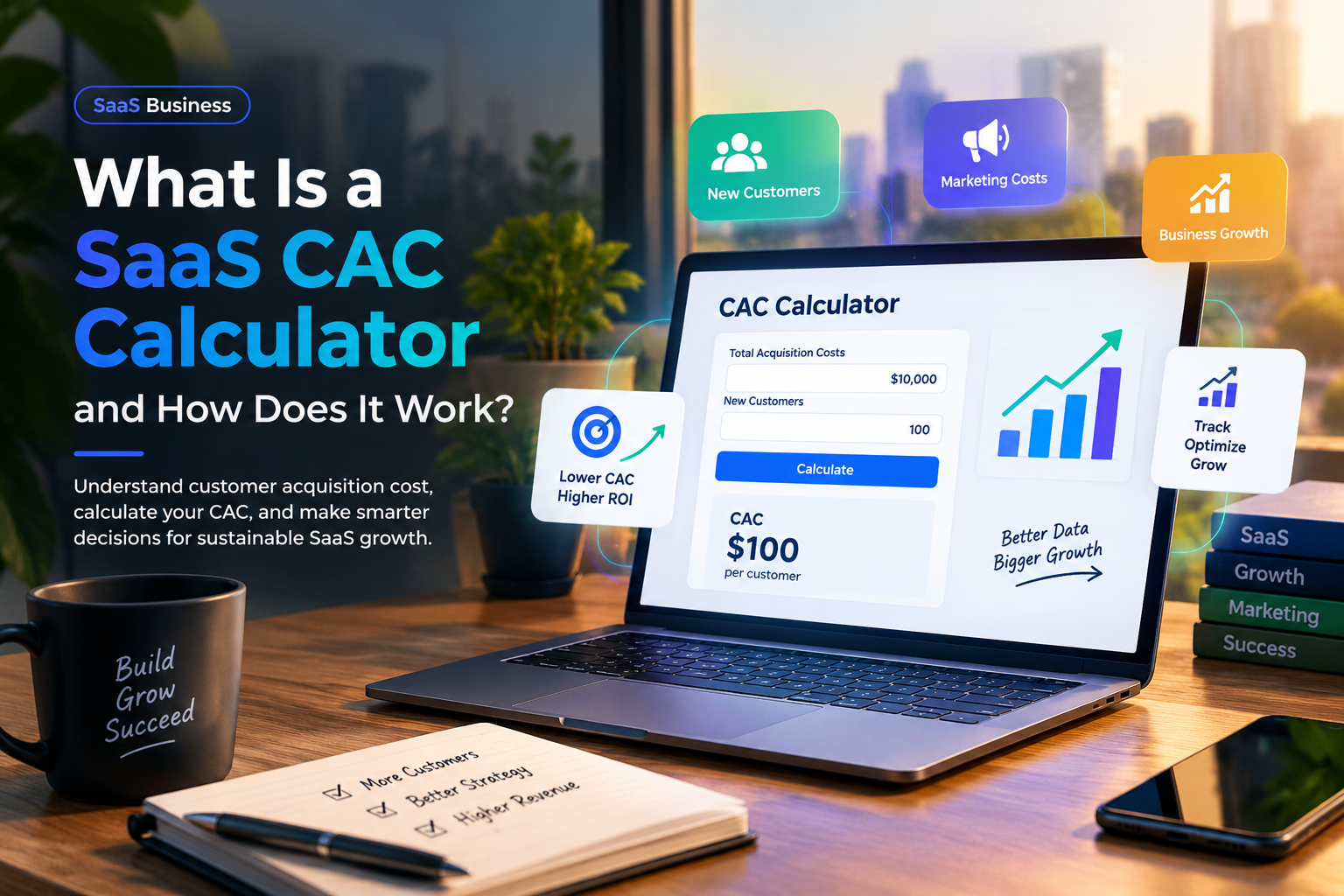
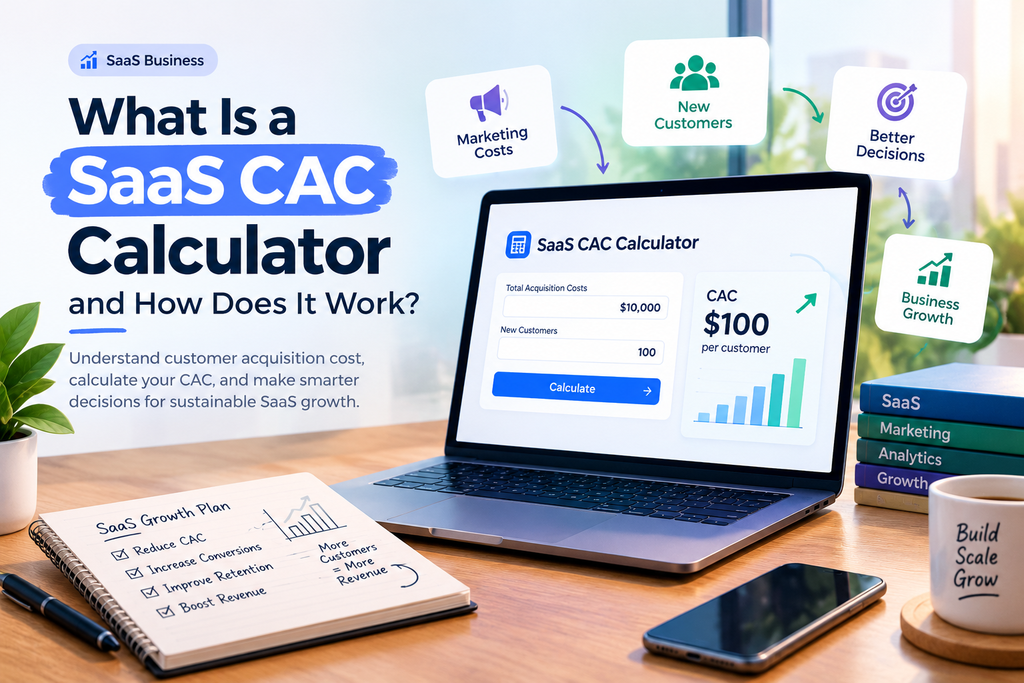
For example, if a SaaS business spends $10,000 on sales and marketing in one month and acquires 100 new paying customers, its customer acquisition cost is $100 per customer. This means the company spends an average of $100 to convert each new customer into a paying subscriber.
However, the value of a CAC calculator goes beyond performing a simple calculation. It can help businesses compare marketing channels, evaluate sales team performance, forecast future expenses, and understand the relationship between acquisition costs and customer lifetime value.
A reliable SaaS CAC calculator is especially useful for startups, growing SaaS companies, subscription software providers, digital product businesses, and established technology companies that want to maintain sustainable customer acquisition practices.
What Does CAC Mean in SaaS?
CAC stands for Customer Acquisition Cost. In the SaaS industry, it represents the average amount of money a company spends to acquire a new paying customer.
Customer acquisition costs can include advertising expenses, marketing campaigns, sales salaries, commissions, marketing software subscriptions, agency fees, and other costs directly associated with attracting and converting customers.
Unlike businesses that generate revenue through one-time product sales, SaaS companies typically earn recurring revenue from monthly or annual subscriptions. As a result, acquisition costs must be evaluated alongside customer retention, recurring revenue, subscription pricing, and customer lifetime value.
For instance, acquiring a customer for $150 may be profitable if that customer generates $1,500 in gross-profit contribution over the relationship. However, spending $150 to acquire a customer who generates only $100 in gross profit could create a financial loss.
This is why SaaS businesses should not evaluate CAC in isolation. They should also consider customer lifetime value (LTV), monthly recurring revenue (MRR), annual recurring revenue (ARR), gross margin, churn rate, and the time required to recover acquisition expenses.
How Does a SaaS CAC Calculator Work?
A SaaS CAC calculator works by collecting sales and marketing expenses for a defined period, counting the new customers acquired during that period, and dividing the total acquisition expenses by the number of new customers.
The calculation usually involves three basic steps.
Step 1: Collect Sales and Marketing Expenses
The first step is identifying all relevant expenses incurred to acquire customers during the selected period. These expenses may include paid advertising, content marketing, SEO campaigns, email marketing tools, sales team compensation, commissions, marketing agency fees, and customer acquisition software.
Businesses should define which costs they include before performing the calculation. A fully loaded CAC calculation generally includes relevant sales and marketing personnel costs, while a narrower calculation may include advertising and campaign expenses only.
Step 2: Count New Paying Customers
The second step is determining how many new customers became paying subscribers during the same period. Companies should distinguish between website visitors, leads, free-trial users, product sign-ups, and actual paying customers.
For example, if a SaaS platform generates 2,000 leads but only 80 become new paying customers, the CAC calculation should use 80 customers rather than 2,000 leads when measuring the cost of acquiring paying subscribers.
Step 3: Calculate Customer Acquisition Cost
After collecting the expenses and customer count, divide total acquisition expenses by the number of new customers acquired.
SaaS CAC Formula:
Customer Acquisition Cost = Total Sales and Marketing Expenses ÷ Number of New Customers Acquired
For example, suppose a SaaS company spends $12,000 on sales and marketing during a month and acquires 120 new paying customers.
CAC = $12,000 ÷ 120
CAC = $100 per customer.
The business therefore spends an average of $100 to acquire each new paying customer. A SaaS CAC calculator performs this calculation automatically and makes it easier to evaluate the results over different periods.
SaaS CAC Calculator Formula Explained
The standard CAC formula is straightforward, but the quality of the result depends on how accurately a business measures its expenses and new customers.
Formula:
CAC = Total Acquisition Costs / New Customers Acquired
The total acquisition cost represents the sales and marketing expenses included in the selected calculation. New customers acquired refers to the number of new paying customers gained during the same period.
Consider the following example:
- Monthly advertising expenses: $4,000
- Sales team expenses: $3,000
- Marketing tools and software: $1,000
- Agency and campaign expenses: $2,000
- Total acquisition expenses: $10,000
- New paying customers: 100
Using the formula, the CAC is $10,000 divided by 100, resulting in a customer acquisition cost of $100.
Businesses should avoid comparing CAC figures calculated using different expense definitions. For example, a CAC figure that includes sales salaries cannot be directly compared with another figure that includes advertising expenses only without accounting for the difference.
Why Is a SaaS CAC Calculator Important?
A SaaS CAC calculator provides valuable insights into the financial efficiency of customer acquisition activities. It helps businesses understand whether their sales and marketing investments are producing customers at a sustainable cost.
1. Measures Marketing Efficiency
A CAC calculator helps businesses determine how much they spend to acquire paying customers. By comparing results across marketing campaigns, companies can identify which strategies produce customers more efficiently.
For example, a business may discover that organic search generates customers at a lower cost than certain paid advertising campaigns. This insight can help the marketing team allocate resources more effectively.
2. Improves Budget Planning
Customer acquisition expenses can increase rapidly as a SaaS business grows. Calculating CAC helps founders and financial teams estimate how much budget may be required to achieve future customer acquisition targets.
If a company expects to acquire 500 customers at an estimated CAC of $120, it can use that assumption to plan for approximately $60,000 in acquisition expenses, subject to changes in conversion rates and market conditions.
3. Supports Sustainable SaaS Growth
Rapid customer growth does not automatically mean a business is profitable. A company may attract many customers while spending too much on acquisition.
Monitoring CAC helps businesses evaluate whether growth is financially sustainable and whether acquisition costs are improving or increasing over time.
4. Helps Evaluate Sales Performance
Sales teams influence how efficiently leads become paying customers. By monitoring CAC alongside lead conversion rates, sales cycle length, and customer quality, businesses can identify opportunities to improve sales processes and reduce unnecessary expenses.
5. Supports Financial Forecasting
CAC data can be used in financial forecasts, growth models, and revenue planning. When combined with subscription revenue, customer lifetime value, churn, and gross margin, acquisition cost data helps businesses evaluate different growth scenarios.
What Costs Should Be Included in a SaaS CAC Calculator?
Accurate CAC calculations depend on identifying the expenses associated with customer acquisition. The appropriate expense categories vary according to the business model and reporting requirements.
Marketing Expenses
Marketing expenses may include paid search advertising, social media campaigns, content creation, SEO services, email marketing, influencer partnerships, public relations, and promotional campaigns.
For SaaS companies that invest heavily in organic growth, content marketing and search engine optimization costs can also be relevant. These activities may not produce customers immediately, but they can contribute to future acquisition.
Sales Expenses
Sales expenses commonly include sales team salaries, commissions, bonuses, sales training, customer relationship management software, prospecting tools, and other costs associated with converting leads into paying customers.
Including relevant sales expenses is particularly important for SaaS companies with enterprise customers and longer sales cycles.
Marketing Technology and Software
Many businesses use analytics platforms, email automation systems, lead-generation tools, customer relationship management software, and campaign management applications. The relevant costs of these tools may be included in a fully loaded CAC calculation.
Agency and Outsourcing Costs
Businesses that hire marketing agencies, SEO specialists, advertising consultants, lead-generation providers, or outsourced sales teams should consider the relevant fees associated with customer acquisition.
Other Relevant Acquisition Costs
Additional expenses may include campaign-related creative production, sales events, acquisition-focused training, and other directly attributable costs.
Businesses should establish a consistent accounting method and avoid including unrelated operational expenses, such as general product development or customer support, in a basic CAC calculation unless their chosen methodology specifically accounts for them.
SaaS CAC Calculation Example
Consider a fictional SaaS company that offers project management software through monthly and annual subscription plans. The company wants to evaluate its customer acquisition performance for September.
Its monthly acquisition expenses are as follows:
| Expense category | Monthly cost |
|---|---|
| Paid advertising | $5,000 |
| Sales salaries and commissions | $4,000 |
| Marketing tools | $1,000 |
| Content and SEO services | $2,000 |
| Agency and campaign costs | $1,000 |
| Total expenses | $13,000 |
During September, the company acquires 130 new paying customers.
CAC = $13,000 ÷ 130 = $100.
The company’s average customer acquisition cost is therefore $100.
The next step is to evaluate whether this amount is financially sustainable. Suppose the average customer generates $50 in monthly recurring revenue and the business has a gross margin of 80%.
Monthly gross profit per customer = $50 × 80% = $40.
Estimated CAC payback period = $100 ÷ $40 = 2.5 months.
Under these simplified assumptions, the company recovers its acquisition cost through gross profit in approximately 2.5 months. Actual results may differ because of customer churn, collection timing, discounts, and other factors.
This example illustrates why CAC becomes more meaningful when evaluated alongside recurring revenue, gross margin, and customer retention.
What Is a Good CAC for a SaaS Business?
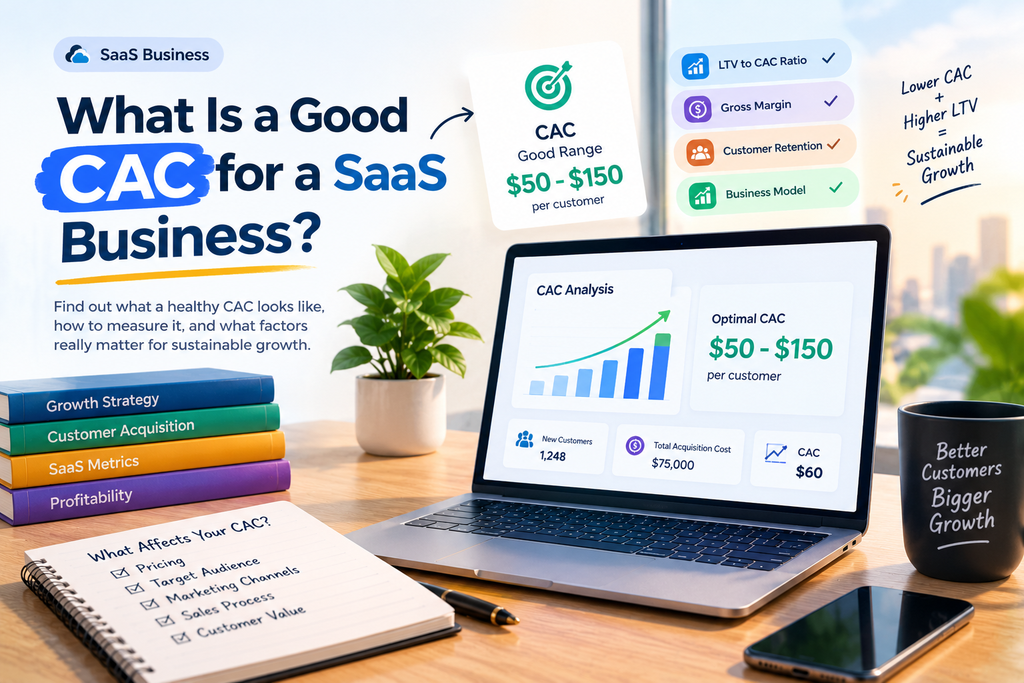
There is no single customer acquisition cost that is considered good for every SaaS company. An acceptable CAC depends on subscription pricing, gross margin, customer lifetime value, retention, sales complexity, and the company’s growth objectives.
A business selling a low-cost subscription may need a relatively low CAC to remain profitable. In contrast, an enterprise SaaS company may reasonably spend much more to acquire a customer who generates substantial recurring revenue over several years.
Instead of comparing CAC with a universal benchmark, businesses should evaluate whether the expected gross profit from a customer can justify the cost of acquisition.
A useful starting point is to examine the relationship between Customer Lifetime Value (LTV) and CAC.
LTV to CAC Ratio = Customer Lifetime Value ÷ Customer Acquisition Cost
For example, if the estimated customer lifetime value is $900 and CAC is $100, the LTV-to-CAC ratio is 9:1.
This means the estimated lifetime value is nine times the acquisition cost, according to the assumptions used in the calculation. However, a high ratio alone does not guarantee success because a company may still face cash-flow challenges, limited market size, or inaccurate lifetime value estimates.
Many SaaS businesses use a ratio near 3:1 as an initial reference point, but the appropriate target depends on the business model, profitability, growth stage, and calculation methodology.
What Is the Difference Between CAC and Customer Lifetime Value?
Customer Acquisition Cost measures the amount spent to acquire a customer, while Customer Lifetime Value estimates the economic value a customer generates throughout the relationship with a business.
CAC focuses on acquisition expenses. LTV focuses on the expected value of the customer relationship.
For example, a company may spend $200 to acquire a customer whose expected lifetime gross profit is $800. In this simplified example, the estimated lifetime gross profit is four times the acquisition cost.
Understanding both metrics helps SaaS companies assess whether their customer acquisition strategies create sustainable economic value.
Businesses should preferably compare CAC with lifetime gross profit rather than relying only on total subscription revenue. Revenue does not account for the costs associated with delivering and supporting the software.
How Does CAC Affect SaaS Growth and Profitability?
CAC influences how much capital a company needs to grow, how quickly acquisition expenses can be recovered, and how effectively marketing investments translate into long-term revenue.
When CAC increases without a corresponding improvement in customer value, profit margins may decline. Companies may need to improve conversion rates, reduce inefficient spending, increase customer retention, or adjust their acquisition strategy.
When CAC decreases while customer quality remains stable, the business may be able to acquire more customers within the same budget. However, reducing acquisition costs should not come at the expense of attracting unsuitable customers who cancel subscriptions quickly.
The objective is not simply to achieve the lowest possible CAC. The goal is to acquire customers efficiently while maintaining strong retention, healthy gross margins, and sustainable recurring revenue.
How to Reduce Customer Acquisition Cost in SaaS
Reducing CAC requires a combination of marketing optimization, better conversion processes, and careful financial analysis.
Improve Organic Search Visibility
Search engine optimization can help SaaS businesses attract users who are actively looking for solutions to their problems. Publishing useful blog posts, creating comparison pages, improving technical SEO, and targeting relevant search queries can contribute to long-term organic customer acquisition.
SEO requires time, expertise, and resources, so its effectiveness should be measured over an appropriate period rather than judged only by immediate results.
Optimize Landing Pages
Clear messaging, relevant calls to action, useful product information, fast page loading, and a straightforward sign-up process can improve conversion rates.
If more qualified visitors become paying customers without a proportional increase in acquisition spending, CAC may decrease.
Improve Lead Quality
Not every lead is equally likely to become a paying customer. SaaS businesses can use customer segmentation, audience targeting, lead scoring, and qualification processes to focus resources on prospects who are more likely to purchase and remain subscribed.
Analyze Marketing Channels Separately
Calculating CAC by channel can reveal differences between paid advertising, organic search, referrals, email marketing, partnerships, and other acquisition sources.
Channel-level analysis should account for attribution limitations and the costs required to support each channel. A lower reported CAC is not necessarily better if the customers acquired have poor retention or low lifetime value.
Strengthen Customer Retention
Although retention does not directly reduce the historical cost of acquiring an existing customer, it can increase customer lifetime value and improve the overall economics of acquisition.
Better onboarding, responsive customer support, useful product improvements, and effective customer education can help reduce churn and encourage longer customer relationships.
Use Automation Strategically
Marketing automation, lead nurturing, analytics, and sales workflow tools can reduce repetitive work and improve operational efficiency. Businesses should compare the cost of these tools with the measurable improvements they deliver.
SaaS CAC Calculator vs. Manual Calculation
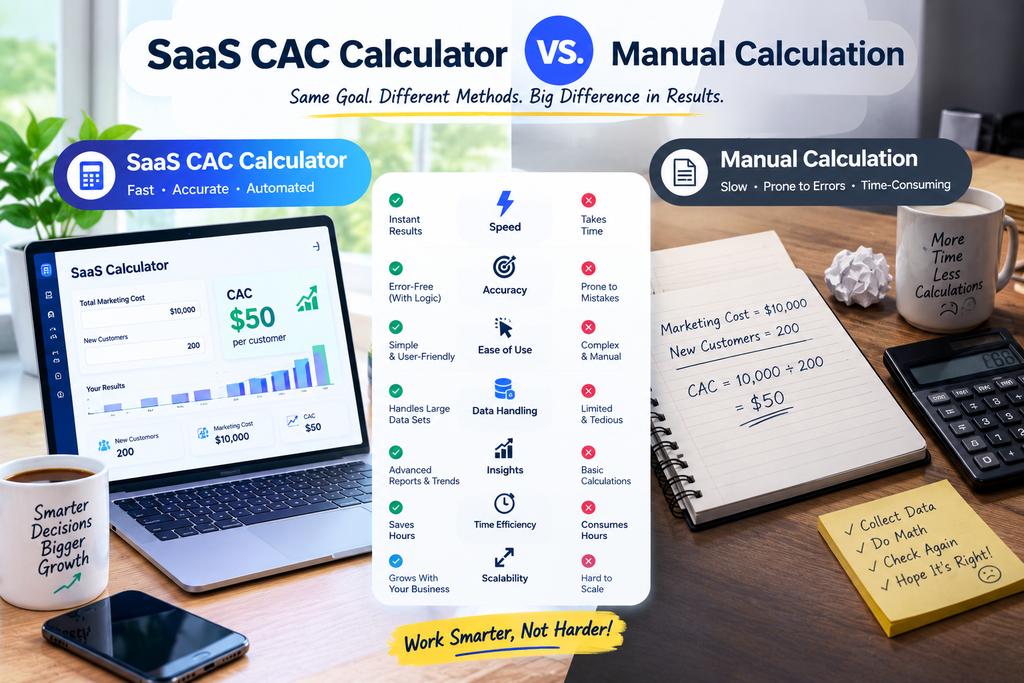
A manual CAC calculation is suitable for a quick estimate when a business has a small amount of data. A SaaS CAC calculator can make the process faster and more consistent, particularly when comparing different periods or testing acquisition scenarios.
Manual calculations require users to gather expenses, count customers, and perform the formula themselves. This can become time-consuming when the business has multiple acquisition channels, several sales teams, or complex reporting requirements.
A calculator simplifies the arithmetic and can make financial analysis easier to repeat. However, it does not automatically guarantee accurate results. The quality of the calculation still depends on reliable financial records, correct customer counts, and a consistent definition of acquisition costs.
Businesses that need more advanced reporting may integrate their calculations with accounting platforms, subscription billing systems, customer relationship management software, and analytics tools.
Common Mistakes to Avoid When Calculating SaaS CAC
Even a simple formula can produce misleading results when the underlying data is inconsistent.
One common mistake is counting leads or free-trial registrations instead of new paying customers. Another is excluding important acquisition expenses, such as sales salaries or agency fees, when the objective is to measure fully loaded CAC.
Companies may also compare CAC across different time periods without accounting for changes in marketing investment, customer conversion, or sales cycles. Enterprise SaaS businesses should be especially careful because acquisition expenses may occur months before a contract is signed.
Another mistake is evaluating CAC without considering customer retention, gross margin, and lifetime value. A low acquisition cost may appear attractive initially, but poor retention can make the acquired customers unprofitable.
To improve reliability, businesses should use consistent reporting periods, document included expenses, distinguish new customers from existing customers, and evaluate CAC alongside other SaaS performance metrics.
Frequently Asked Questions About SaaS CAC Calculators
1. What is a SaaS CAC calculator used for?
A SaaS CAC calculator is used to measure the average cost of acquiring a new paying customer. It helps businesses analyze sales and marketing efficiency, plan acquisition budgets, compare channels, and evaluate the financial sustainability of customer growth.
2. How do you calculate CAC for a SaaS company?
Divide the relevant sales and marketing expenses for a defined period by the number of new paying customers acquired during that same period. For example, $15,000 in acquisition expenses divided by 150 new customers results in a CAC of $100.
3. What expenses should be included in CAC?
Common expenses include paid advertising, marketing personnel, sales salaries, commissions, marketing software, agency fees, content marketing, SEO services, and other relevant acquisition-related costs. The exact scope depends on whether the company is calculating paid-media CAC or fully loaded CAC.
4. What is a good CAC for SaaS startups?
A good CAC depends on the startup’s pricing, gross margin, customer lifetime value, retention, and business model. Startups should determine whether the expected gross profit generated by customers justifies their acquisition expenses instead of relying on a universal dollar amount.
5. What is the difference between CAC and LTV?
CAC measures the cost of acquiring a customer, while LTV estimates the value generated throughout the customer relationship. Comparing LTV with CAC helps businesses evaluate acquisition efficiency and long-term unit economics.
6. Can a SaaS CAC calculator help improve profitability?
Yes. A CAC calculator can identify expensive acquisition strategies, support better budget allocation, and help businesses monitor the cost of growth. Profitability improvements depend on acting on the results and considering other metrics, including gross margin and customer retention.
7. How often should a SaaS company calculate CAC?
Many SaaS businesses monitor CAC monthly and review trends quarterly. Companies with high advertising spend or rapid growth may benefit from more frequent monitoring, while businesses with long enterprise sales cycles may also need longer reporting windows.
8. Does a SaaS CAC calculator measure marketing ROI?
A CAC calculator measures acquisition cost rather than marketing return on investment directly. To evaluate marketing ROI, businesses need additional information about the revenue or profit attributable to their marketing activities and the associated costs.
Conclusion
A SaaS CAC calculator is an essential tool for understanding the financial efficiency of customer acquisition in subscription-based software businesses. By dividing sales and marketing expenses by the number of new paying customers, businesses can determine their average acquisition cost and make better-informed decisions about marketing investments, sales performance, and growth planning.
However, CAC should never be evaluated in isolation. Combining customer acquisition cost with customer lifetime value, monthly recurring revenue, annual recurring revenue, gross margin, customer retention, and CAC payback period provides a more complete picture of SaaS business performance.
For startups and established software companies alike, consistent CAC tracking can reveal inefficient spending, support more realistic financial forecasts, and help teams identify sustainable growth opportunities.
Whether you are launching a new SaaS product or scaling an established subscription business, using a SaaS CAC calculator can help turn acquisition data into actionable insights. With accurate inputs, consistent measurement, and ongoing optimization, businesses can build stronger customer acquisition strategies and improve their long-term financial performance.




Leave a Reply