


Monthly recurring revenue (MRR) is one of the most important financial metrics for subscription-based businesses. An MRR Calculator helps SaaS companies accurately calculate monthly recurring revenue, track subscription income, and evaluate business growth. Whether a company offers cloud software, digital subscriptions, or business automation solutions, using an MRR Calculator to understand predictable monthly revenue is essential for effective financial planning and sustainable long-term growth.
An MRR Calculator is a financial tool that helps SaaS businesses calculate monthly recurring revenue, evaluate subscription performance, and measure changes in recurring income. Instead of manually calculating subscription payments, businesses can use an MRR Calculator to estimate how much recurring revenue their active customers generate each month.
For B2B SaaS companies, monitoring monthly recurring revenue provides valuable information about customer retention, subscription upgrades, cancellations, and business growth.
However, calculating MRR involves more than simply adding monthly subscription payments. Businesses must consider billing cycles, discounts, customer upgrades, downgrades, and subscription cancellations to maintain accurate financial reporting.
This guide explains what an MRR Calculator is, how it works, how to calculate SaaS monthly recurring revenue, and how businesses can use recurring revenue metrics to make informed decisions.
What Is an MRR Calculator?
An MRR Calculator, or Monthly Recurring Revenue Calculator, is a tool designed to calculate the predictable recurring revenue generated by subscription-based customers during a month.
MRR represents the normalized monthly value of active recurring subscriptions rather than the total cash collected during that month.
For example, if a SaaS company has 200 customers paying $50 per month, its monthly recurring revenue is $10,000.
An MRR Calculator can simplify this process by allowing business owners to enter subscription data and automatically calculate the corresponding recurring revenue.
More advanced calculators may also help companies evaluate customer acquisition, subscription expansion, customer churn, and revenue growth.
Why Is MRR Important for SaaS Businesses?
Subscription-based businesses rely on recurring customer payments rather than individual purchases. As a result, tracking predictable revenue is essential for understanding financial stability.
MRR helps businesses:
- Monitor recurring subscription income.
- Understand monthly revenue growth.
- Identify customer retention problems.
- Evaluate subscription pricing strategies.
- Plan operating expenses and future investments.
- Measure the performance of subscription upgrades.
- Understand how cancellations affect revenue.
- Forecast potential recurring revenue trends.
Although MRR is an important performance indicator, businesses should analyze it alongside expenses, profit margins, cash flow, and customer acquisition costs.
MRR alone does not indicate whether a SaaS business is profitable.
How Does an MRR Calculator Work?
An MRR Calculator uses subscription information to determine the monthly value of recurring customer payments.
The calculation process generally involves identifying active subscriptions, normalizing different billing periods, and combining the recurring revenue amounts.
Step 1: Identify Active Paying Customers
Start by identifying the customers with active paid subscriptions during the selected reporting period.
For example, a SaaS business may have 500 active subscribers using different subscription plans.
Free users generally do not contribute to monthly recurring revenue unless they have an active paid subscription.
Step 2: Determine Subscription Revenue
Identify the recurring payment associated with each subscription.
A SaaS company may offer three pricing plans:
| Subscription Plan | Monthly Price | Customers |
|---|---|---|
| Basic | $20 | 150 |
| Professional | $50 | 100 |
| Enterprise | $100 | 50 |
The calculator multiplies the number of customers in each plan by the corresponding monthly subscription price.
Step 3: Normalize Billing Periods
Not every SaaS customer pays monthly.
Some customers subscribe to quarterly or annual plans.
For consistent calculations, longer subscription periods must be converted into monthly equivalents.
For example, a customer paying $1,200 annually contributes $100 to monthly recurring revenue.
This normalized amount should be included in MRR, even if the customer paid the full annual subscription upfront.
Step 4: Calculate Total Monthly Recurring Revenue
Once subscription amounts are normalized, the calculator combines the monthly recurring revenue from all eligible active subscriptions.
Using the earlier pricing example:
- Basic: 150 × $20 = $3,000
- Professional: 100 × $50 = $5,000
- Enterprise: 50 × $100 = $5,000
Total MRR = $13,000
The SaaS business generates $13,000 in normalized monthly recurring subscription revenue.
MRR Calculator Formula Explained
The basic monthly recurring revenue formula is:
MRR = Number of Customers × Average Revenue Per Account
For example:
A SaaS company has 400 paying customers, with an average monthly recurring revenue of $75 per customer account.
MRR = 400 × $75
Monthly Recurring Revenue = $30,000
This formula works when the average revenue figure accurately represents recurring monthly revenue across active customer accounts.
For businesses offering multiple subscription packages, calculating MRR separately for each pricing plan may produce more transparent results.
MRR Formula for Multiple Subscription Plans
When customers pay different subscription prices, businesses can use:
Total MRR = Sum of Monthly Recurring Revenue From All Active Subscriptions
Consider a company offering:
- Starter Plan: 100 customers paying $25 monthly.
- Growth Plan: 75 customers paying $80 monthly.
- Premium Plan: 25 customers paying $200 monthly.
The calculation becomes:
Starter MRR = $2,500
Growth MRR = $6,000
Premium MRR = $5,000
Total MRR = $13,500
This approach helps businesses understand which subscription plans contribute most significantly to recurring revenue.
Different Types of MRR Every SaaS Business Should Understand
Monthly recurring revenue can be divided into several categories that explain how subscription revenue changes.
Understanding these categories makes an MRR Calculator more useful for evaluating business performance.
1. New MRR
New MRR represents additional recurring revenue generated from newly acquired paying customers.
For example, if a SaaS business acquires 20 new subscribers paying $100 monthly:
New MRR = 20 × $100
New MRR = $2,000
This metric helps companies measure subscription revenue generated through new customer acquisition.
2. Expansion MRR
Expansion MRR represents additional recurring revenue generated from existing customers.
This may result from:
- Subscription upgrades.
- Additional user licenses.
- Recurring add-on subscriptions.
- Increased subscription commitments.
For example, when 10 customers upgrade from $50 to $100 monthly plans, the additional recurring revenue is $500.
Expansion MRR helps measure the ability of a business to grow revenue from its existing customer base.
3. Churned MRR
Churned MRR represents recurring revenue lost when customers cancel their subscriptions.
For example, if five customers paying $80 monthly cancel:
Churned MRR = 5 × $80
Churned MRR = $400
Monitoring churned MRR helps businesses identify revenue losses caused by subscription cancellations.
4. Contraction MRR
Contraction MRR represents recurring revenue reductions from customers who remain subscribed but reduce their spending.
For example, a customer downgrading from a $200 monthly plan to a $100 plan creates $100 in contraction MRR.
Unlike churned MRR, contraction MRR does not necessarily involve losing the customer.
5. Net New MRR
Net New MRR measures the overall change in recurring revenue during a reporting period.
The formula is:
Net New MRR = New MRR + Expansion MRR − Churned MRR − Contraction MRR
Suppose a SaaS company reports:
| MRR Component | Amount |
|---|---|
| New MRR | $5,000 |
| Expansion MRR | $2,000 |
| Churned MRR | $1,000 |
| Contraction MRR | $500 |
| Net New MRR | $5,500 |
This means the company increased its monthly recurring revenue by $5,500 during the selected period.
If starting MRR was $40,000, ending MRR would be $45,500, assuming no additional adjustments.
How Can SaaS Businesses Use an MRR Calculator?
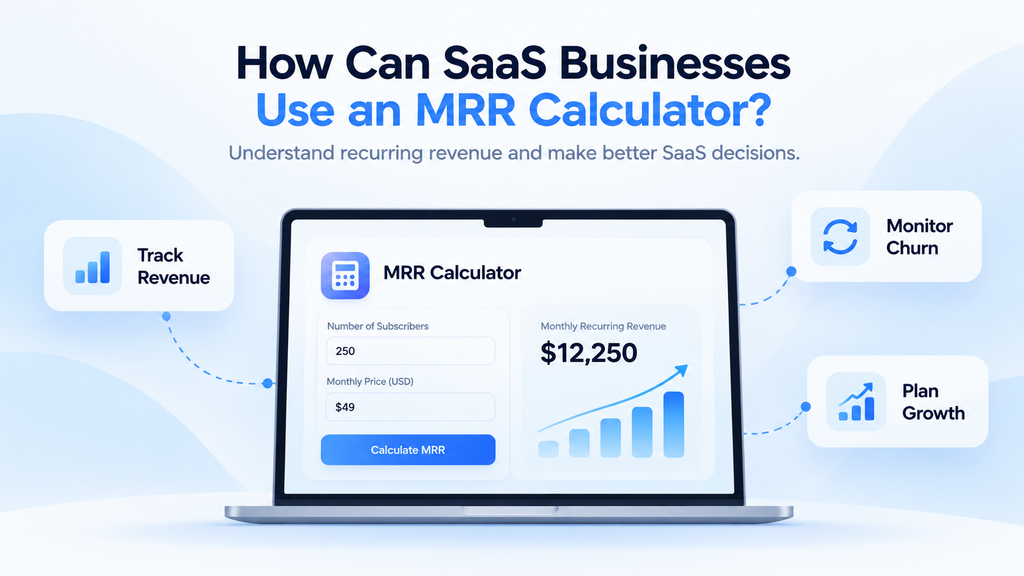
An MRR Calculator is more than a financial calculation tool. It can support subscription management, revenue analysis, and long-term business planning.
Monitor Monthly Subscription Growth
SaaS businesses can calculate MRR at the end of each reporting period to identify recurring revenue changes.
For example:
| Month | MRR |
|---|---|
| January | $10,000 |
| February | $11,500 |
| March | $13,000 |
| April | $15,000 |
This information shows the company’s historical recurring revenue trend.
Businesses can compare monthly values to identify whether recurring revenue is increasing, remaining stable, or declining.
However, revenue growth should also be evaluated against acquisition spending, operational costs, and customer retention.
Improve Subscription Pricing Strategies
Subscription pricing directly affects monthly recurring revenue.
An MRR Calculator helps businesses understand the recurring revenue contribution of different pricing packages.
For example, a company may discover that its Professional subscription plan generates more MRR than its Starter plan despite having fewer customers.
This insight may encourage the company to investigate:
- Which features encourage upgrades.
- Whether pricing matches customer value.
- Which plans attract long-term customers.
- How discounts affect recurring revenue.
- Which packages generate sustainable expansion.
Pricing decisions should also consider conversion rates, customer satisfaction, competitive positioning, and profitability.
Understand Customer Retention
Customer retention is essential for subscription-based businesses because cancellations reduce recurring revenue.
An MRR Calculator that supports churn analysis can help companies measure recurring revenue lost through subscription cancellations.
For example, a company with $50,000 in beginning MRR that loses $2,500 through customer cancellations and downgrades has a 5% gross revenue churn rate for the period.
Businesses can use this information to investigate cancellation reasons, improve customer support, and strengthen onboarding processes.
Support Financial Forecasting
Historical MRR data can help SaaS companies create revenue forecasts.
For example, a business generating $20,000 MRR may model how revenue could change under different customer acquisition and churn assumptions.
Forecasting scenarios may include:
- Conservative subscription growth.
- Stable revenue without significant expansion.
- Higher growth through customer acquisition.
- Revenue declines caused by increased churn.
An MRR Calculator provides a useful starting point for these projections.
However, forecasts are estimates rather than guaranteed future outcomes.
Measure Marketing Performance
Marketing teams can compare changes in MRR with campaign costs and customer acquisition metrics.
For example, a B2B SaaS company may invest in organic SEO, content marketing, and paid advertising to acquire new subscribers.
By tracking revenue from newly acquired customers, businesses can better understand the financial outcomes associated with marketing efforts.
However, MRR should not be treated as an isolated measure of marketing ROI.
Businesses should also consider customer acquisition cost, customer lifetime value, conversion rates, and gross margins.
MRR Calculator vs ARR Calculator
| Feature | MRR Calculator | ARR Calculator |
|---|---|---|
| Full Name | Monthly Recurring Revenue | Annual Recurring Revenue |
| Reporting Period | Monthly | Annual |
| Main Purpose | Track monthly subscription revenue | Evaluate annualized subscription revenue |
| Best For | Monthly growth monitoring | Annual planning and reporting |
| Common SaaS Use | Subscription performance analysis | Annual revenue planning |
How to Calculate ARR From MRR
The standard formula is:
ARR = MRR × 12
For example, if a SaaS company generates $25,000 MRR:
ARR = $25,000 × 12
ARR = $300,000
This represents an annualized run rate based on current monthly recurring revenue.
It does not guarantee that the company will collect $300,000 over the next twelve months.
Actual revenue may change because of cancellations, upgrades, downgrades, and customer acquisition.
MRR Calculator vs Revenue Calculator
Although both tools measure revenue-related information, their purposes differ.
A general revenue calculator may include one-time product sales, implementation fees, consulting income, and other payments.
An MRR Calculator focuses specifically on normalized recurring subscription revenue.
For example, consider a SaaS company receiving:
- $15,000 in recurring subscription revenue.
- $3,000 in one-time setup fees.
- $2,000 in consulting payments.
Its total revenue from these sources for the month is $20,000, assuming the listed amounts are recognized in that period.
However, its MRR is generally $15,000 because one-time setup and consulting fees are excluded.
This distinction helps prevent businesses from overstating their recurring revenue.
How to Calculate MRR for Annual SaaS Subscriptions
Annual subscriptions require special attention when calculating monthly recurring revenue.
A customer paying $2,400 annually does not contribute $2,400 to MRR.
Instead, the annual recurring contract amount is divided by twelve.
Monthly Recurring Revenue = Annual Subscription Value ÷ 12
For example:
Annual Subscription = $2,400
MRR = $2,400 ÷ 12
MRR = $200
If a company has 50 customers with the same annual subscription value:
Total MRR = 50 × $200
Total MRR = $10,000
An accurate SaaS MRR Calculator should normalize eligible subscription amounts consistently, regardless of whether customers pay monthly, quarterly, or annually.
How an MRR Calculator Supports B2B SaaS SEO
Search engine optimization plays an important role in attracting potential customers to SaaS websites.
B2B SaaS businesses often invest in SEO to generate organic traffic, educate prospective buyers, and increase subscription conversions.
An MRR Calculator can help businesses connect subscription revenue performance with marketing analysis.
Track Organic Customer Acquisition
SaaS companies can use analytics tools to identify customers acquired through organic search.
For example, potential customers may discover a software platform through:
- Informational blog articles.
- Product comparison pages.
- SaaS feature pages.
- Industry-specific landing pages.
- Search-optimized educational resources.
Businesses can then use subscription data to estimate new MRR associated with customers acquired through organic channels.
Reliable attribution requires consistent analytics and customer records because buyers may interact with multiple channels before subscribing.
Evaluate SEO-Driven Subscription Growth
Organic traffic alone does not guarantee subscription revenue.
A website may receive thousands of visitors without generating meaningful customer conversions.
By comparing SEO performance with new customer MRR, businesses can develop a clearer picture of how organic search contributes to customer acquisition.
Useful supporting metrics include:
- Organic conversion rate.
- New customers acquired through organic search.
- New MRR attributed to organic acquisition.
- Customer acquisition cost.
- Customer retention.
- Subscription upgrade activity.
These metrics provide more useful business context than website traffic alone.
Improve SaaS Content Strategy
Analyzing conversion and recurring revenue data may help marketers identify which types of SEO content attract qualified prospects.
For example, comparison articles and product-specific tutorials may attract readers who are closer to a purchasing decision than some broad informational searches.
Businesses can use this information to refine content planning, improve internal linking, and create relevant calls to action.
The objective is not simply to increase traffic but to attract visitors who may find genuine value in the SaaS product.
Essential Features of a Good SaaS MRR Calculator
Not every MRR Calculator provides the same level of functionality.
A basic calculator may only multiply customer count by average monthly revenue, while more advanced tools can support detailed subscription analysis.
Multiple Subscription Plans
A useful calculator should allow businesses to evaluate recurring revenue from different pricing tiers.
This is particularly important for SaaS companies offering Starter, Professional, Business, and Enterprise subscriptions.
Monthly and Annual Billing Support
A reliable MRR Calculator should normalize subscription amounts across billing periods.
Annual and quarterly plans should be converted into monthly equivalents to maintain consistent calculations.
Churn and Expansion Tracking
Advanced calculators may include separate fields for new, expansion, churned, and contraction MRR.
These inputs help businesses understand how recurring revenue changes over time.
Accurate Discount Handling
Discounts can affect the normalized recurring value of subscriptions.
A calculator should apply a consistent policy for recurring discounts and distinguish temporary promotional reductions from permanent pricing changes.
Clear Financial Results
The calculator should display results in an understandable format.
Helpful outputs may include current MRR, net new MRR, annualized recurring revenue, and subscription growth rates.
For more detailed calculations, users may also benefit from historical comparisons and visual revenue charts.
Common Mistakes When Using an MRR Calculator
Even a well-designed calculator can produce misleading results when incorrect information is entered.
Understanding common mistakes helps SaaS businesses maintain more reliable subscription reporting.
Including One-Time Payments
One-time setup fees, consulting services, and nonrecurring charges should generally be excluded from MRR.
Including these amounts can overstate predictable subscription revenue.
Treating Annual Payments as Monthly MRR
Annual subscription payments should be converted into monthly equivalents rather than counted entirely in the payment month.
Otherwise, MRR may appear artificially high during periods when annual subscriptions are billed.
Ignoring Subscription Cancellations
Businesses must account for cancelled subscriptions when evaluating current recurring revenue.
Failing to reflect cancellations may create an inaccurate picture of ongoing subscription income.
Mixing Different Reporting Periods
Comparisons should use consistent reporting dates and definitions.
For example, comparing beginning-of-month MRR with another month’s ending MRR without identifying the reporting basis can lead to confusion.
Confusing MRR With Cash Flow
MRR measures normalized subscription revenue, not cash held in a bank account.
A company may collect substantial annual prepayments while reporting a much smaller monthly recurring revenue amount.
Similarly, operational expenses can exceed MRR even when recurring revenue is growing.
How Often Should SaaS Businesses Calculate MRR?
Most subscription-based businesses benefit from monitoring MRR monthly.
Monthly reporting helps teams evaluate recurring revenue trends, customer acquisition, and subscription changes using consistent periods.
However, businesses experiencing rapid subscription activity may monitor supporting revenue data more frequently.
A practical reporting approach includes reviewing current MRR, net new MRR, churn, and expansion at the end of each month.
Quarterly reviews can help identify broader trends and evaluate whether pricing, customer acquisition, or retention strategies require adjustment.
Annual reviews can support strategic planning and comparison with longer-term business objectives.
The appropriate reporting frequency depends on the company’s size, subscription model, and operational requirements.

Best Practices for Improving SaaS MRR
Increasing recurring revenue requires more than acquiring additional customers.
Businesses should focus on delivering product value, supporting existing customers, and maintaining financially sustainable subscription growth.
Strengthen Customer Onboarding
Clear onboarding helps customers understand how to use the software and achieve their intended outcomes.
Helpful tutorials, product documentation, and customer support may improve the initial customer experience.
Improve Customer Retention
Customer feedback, reliable product performance, and responsive support can help businesses identify and address retention problems.
Retention improvements may reduce recurring revenue losses associated with churn.
Encourage Relevant Subscription Upgrades
Businesses can offer higher-tier plans with additional capabilities for customers who genuinely need those features.
Upgrade opportunities should communicate clear value rather than encourage customers to purchase unnecessary functionality.
Review Subscription Pricing
Pricing should reflect product value, operating costs, competitive conditions, and customer needs.
Businesses can evaluate whether existing subscription plans remain appropriate as their products evolve.
Measure Revenue Quality
MRR growth should be evaluated alongside gross margin, customer acquisition cost, retention, and overall profitability.
A SaaS company experiencing rapid MRR growth may still face financial difficulties if customer acquisition and operating expenses are unsustainable.
Frequently Asked Questions About MRR Calculators
What is an MRR Calculator in SaaS?
An MRR Calculator is a financial tool that measures normalized monthly recurring revenue from active customer subscriptions. It helps SaaS businesses monitor recurring income and analyze subscription performance.
How do you calculate MRR?
The basic formula is MRR = Number of Paying Customers × Average Monthly Recurring Revenue Per Account. For different subscription plans, calculate each plan’s normalized recurring revenue and combine the results.
What is the difference between MRR and ARR?
MRR represents monthly recurring revenue, while ARR represents annualized recurring revenue. For a simple annualization based on current MRR, multiply MRR by twelve.
Can an MRR Calculator include annual subscriptions?
Yes. Annual subscriptions can be included by dividing their eligible annual recurring value by twelve to calculate their monthly equivalent.
Does MRR include one-time payments?
Generally, no. One-time setup fees, consulting payments, and nonrecurring charges are excluded because they do not represent ongoing subscription revenue.
Why is MRR important for B2B SaaS companies?
MRR helps B2B SaaS companies understand recurring revenue trends, evaluate customer retention, monitor subscription growth, and support financial planning.
Can an MRR Calculator measure SaaS SEO ROI?
An MRR Calculator can support SEO performance analysis by measuring recurring revenue associated with acquired customers. However, calculating SEO ROI also requires investment costs, appropriate revenue attribution, and other financial information.
Is increasing MRR always a sign of business success?
Not necessarily. Rising MRR indicates recurring revenue growth, but companies must also consider profitability, customer acquisition costs, churn, cash flow, and operating expenses.
Conclusion
An MRR Calculator is an important financial tool for SaaS businesses that want to understand subscription revenue, monitor growth, and make informed financial decisions.
By calculating normalized monthly recurring revenue, companies can measure the contribution of active subscriptions, identify revenue losses from cancellations, and understand how customer upgrades affect recurring income.
For B2B SaaS businesses, an MRR Calculator can also support subscription pricing analysis, financial forecasting, and marketing performance measurement.
When combined with customer retention metrics, acquisition costs, and profitability analysis, MRR provides valuable insights into the sustainability of a subscription-based business.
Ultimately, businesses that consistently track monthly recurring revenue and understand the factors influencing it are better equipped to evaluate performance, improve subscription strategies, and plan for long-term SaaS growth.







Leave a Reply