
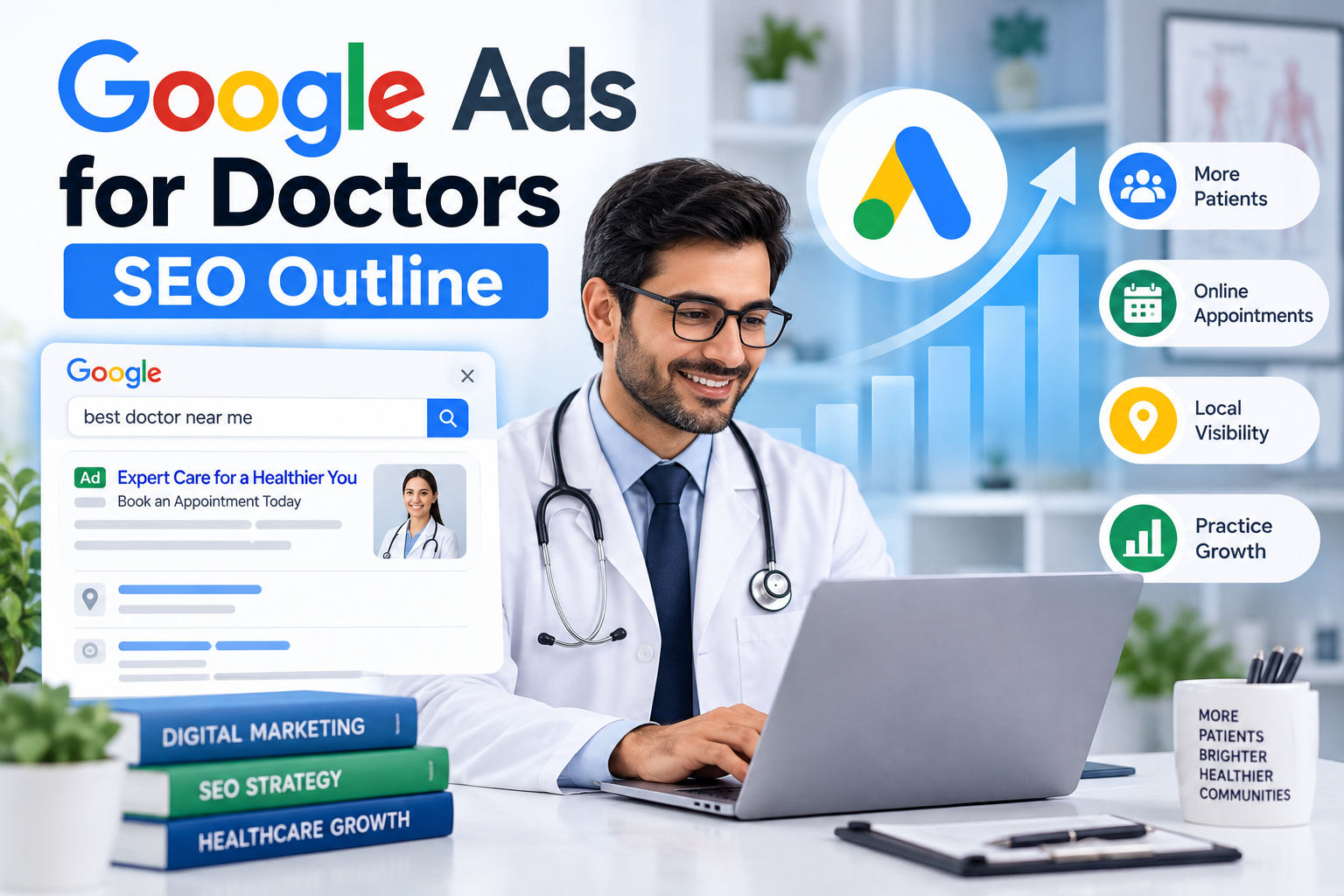

Google Ads for Doctors SEO Outline gives medical practices a practical way to combine paid search with organic SEO for stronger online visibility and better patient acquisition. A well-planned Google Ads for Doctors SEO Outline can help clinics target high-intent keywords, improve local search presence, optimize important service pages, attract qualified traffic, and turn more website visitors into appointment inquiries while building long-term search growth.
This makes both Google Ads for doctors and SEO important parts of a modern healthcare marketing strategy.
Google Ads can help doctors appear quickly in paid search results, while SEO helps medical websites improve their organic rankings over time. When these two strategies work together, a clinic can gain stronger search visibility, attract more qualified traffic, increase appointment requests, and build a sustainable online presence.
Instead of choosing only Google Ads or SEO, doctors can often achieve better results by using paid advertising for immediate visibility and SEO for long-term organic growth.
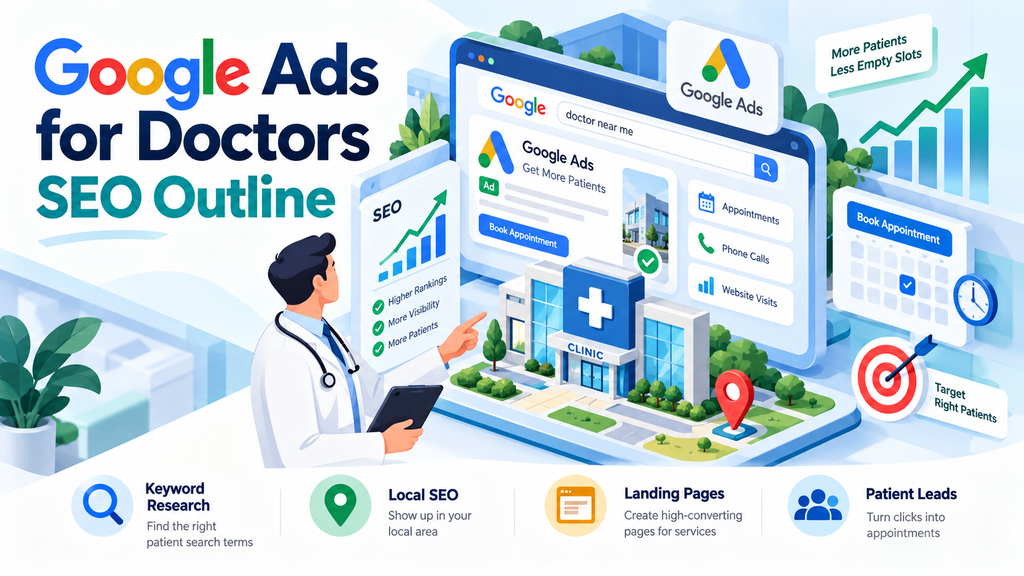
What Are Google Ads for Doctors?
Google Ads allows doctors and clinics to display advertisements when people search for relevant medical services.
For example, a patient may search for:
- Dermatologist near me
- Cardiologist in Lahore
- Best dentist near me
- Pediatrician appointment
- Skin specialist in Karachi
A doctor running a relevant Google Ads campaign may appear near the top of the search results.
The main advantage of Google Ads is speed. A new medical website may take time to build strong organic rankings, but paid advertising can potentially start bringing targeted search traffic much sooner.
Doctors can use Google Ads to promote services, generate phone calls, encourage appointment bookings, and reach people within specific locations.
However, paid traffic alone does not create long-term search authority. This is where SEO becomes important.
What Is SEO for Doctors?
SEO for doctors is the process of improving a medical website so that it can become more visible in organic search results.
Unlike Google Ads, organic SEO does not require paying for every website click.
Doctors SEO usually includes several areas:
- Keyword research
- Local SEO
- Medical content optimization
- Technical SEO
- On-page optimization
- Google Business Profile optimization
- Internal linking
- Website speed improvements
- Mobile optimization
- Local citations
- Authority building
The main objective is to help search engines understand the doctor’s services, location, expertise, and website content.
For example, if a dermatologist wants to rank for “dermatologist in Multan,” the website may need an optimized service page, relevant local information, useful content, strong technical performance, and local SEO signals.
Over time, successful SEO can help attract patients without depending entirely on paid advertising.
Why Google Ads and SEO Work Better Together
Google Ads and doctors SEO solve different marketing challenges.
Google Ads focuses on immediate search visibility.
SEO focuses on long-term organic visibility.
When both are used together, doctors can potentially appear in both paid and organic areas of Google search results.
This can create greater overall search presence.
For example, someone searches:
“skin specialist near me”
A clinic may appear in a paid advertisement at the top of the page and also appear organically through local or traditional SEO.
Seeing the same medical practice in multiple areas of search results can improve visibility and reinforce brand recognition.
More importantly, doctors can use data from paid advertising to strengthen their SEO strategy.
Use Google Ads Data to Improve Doctors SEO
One of the biggest advantages of combining Google Ads with SEO is access to search data.
Google Ads campaigns can reveal which searches generate clicks and conversions.
Suppose a clinic targets several keywords:
“dermatologist near me”
“acne treatment clinic”
“skin doctor appointment”
“hair loss specialist”
Over time, the clinic may discover that searches for “acne treatment clinic” generate a large number of appointment inquiries.
The SEO team can then create or improve an organic page targeting acne treatment.
This means Google Ads can help identify valuable search opportunities that can later become part of the doctor’s long-term SEO strategy.
Instead of guessing which keywords are valuable, doctors can use real campaign performance data.
Keyword Research for Google Ads and Doctors SEO
Keyword research is essential for both paid and organic search marketing.
However, keyword selection should focus on patient intent.
A keyword such as:
“cardiology”
is very broad.
Someone using that search may simply be looking for information.
A keyword such as:
“cardiologist near me”
shows much stronger intent to find a doctor.
Other useful medical keyword patterns include:
“[specialist] near me”
“[service] in [city]”
“book [doctor type] appointment”
“[medical treatment] clinic”
“best [specialist] in [location]”
Doctors can use high-intent keywords in Google Ads while also developing dedicated SEO pages around the same search topics.
This creates consistency between paid and organic marketing.
Local SEO and Google Ads for Doctors
Local search is extremely important for medical practices because most patients prefer doctors located within a convenient distance.
Google Ads allows doctors to target specific locations.
A clinic can target users within:
A particular city
Nearby neighborhoods
A defined geographic radius
Selected locations around clinic branches
SEO can strengthen this local strategy through local optimization.
Important local SEO actions include:
- Optimizing the Google Business Profile
- Using accurate clinic name, address, and phone information
- Creating location-specific service pages
- Adding relevant local keywords
- Earning local citations
- Collecting authentic patient reviews where appropriate
- Creating locally relevant medical content
For example, a dental clinic in Islamabad could run Google Ads targeting “dentist in Islamabad” while also optimizing its website organically for similar local searches.
This combination helps the clinic compete for both immediate and long-term visibility.
Build SEO Landing Pages for Google Ads
Doctors should avoid sending every advertisement to a generic homepage.
A better approach is to create service-specific landing pages.
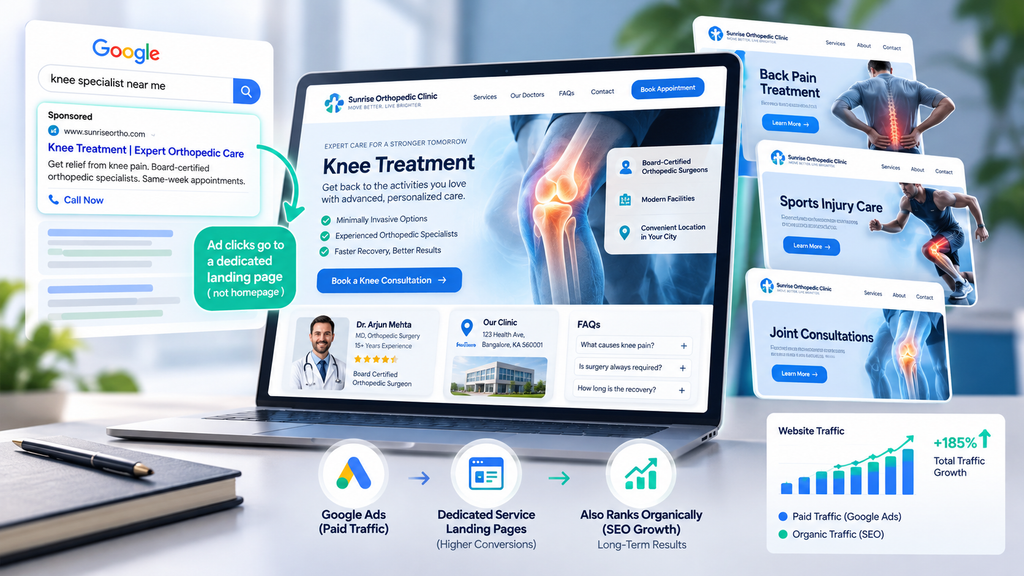
Imagine an orthopedic clinic provides:
Knee treatment
Back pain treatment
Sports injury care
Joint consultations
Instead of directing every Google Ads visitor to the homepage, the clinic can create separate optimized pages for each major service.
A user searching for “knee specialist near me” could be sent to a dedicated knee treatment page.
That page can include:
Relevant service information
Doctor credentials
Clinic location
Frequently asked questions
Appointment options
Contact details
Clear calls to action
These pages can work for Google Ads and also become valuable SEO assets.
A properly optimized landing page may later rank organically for relevant searches.
This is one of the strongest ways to connect PPC and SEO.
Create Helpful Medical Content
Google Ads usually focuses on people who are ready to take action.
SEO can reach patients earlier in their research journey.
For example, someone may search:
“What causes persistent knee pain?”
This person may not be ready to book an appointment yet.
A useful SEO article can answer the question and introduce the clinic’s expertise.
Later, the visitor may return when they are ready to consult a doctor.
Medical practices can create content around:
Common symptoms
Treatment information
Frequently asked questions
Preparation for appointments
General educational health topics
Service comparisons
Recovery information
Content should be clear, accurate, responsible, and useful.
Doctors should avoid exaggerated claims and ensure that medical information is written or reviewed appropriately.
Google Ads Can Support New SEO Campaigns
SEO usually takes time to develop.
When a clinic creates a new service page, it may not rank immediately.
Google Ads can help bring relevant visitors to that page while its organic visibility develops.
For example, a clinic launches a new page about:
“Sports Injury Treatment”
The SEO team optimizes the page for relevant search terms.
At the same time, the clinic can run Google Ads targeting searches related to sports injury doctors.
This provides immediate traffic while SEO performance builds gradually.
It can also help the clinic understand how users interact with the page.
Improve Website Experience for Both Ads and SEO
Website quality affects both paid campaigns and organic performance.
A slow, confusing, or poorly designed medical website can reduce conversions regardless of how visitors arrive.
Doctors should focus on:
Fast page loading
Mobile-friendly design
Simple navigation
Clear service descriptions
Visible contact information
Secure browsing
Easy appointment options
Readable content
A strong website can improve the effectiveness of Google Ads because visitors are more likely to convert.
At the same time, better website usability and technical performance can support SEO.
Therefore, website optimization should be treated as part of both strategies.
Use Conversion Tracking to Measure Real Results
Doctors should not judge marketing success only by clicks or website traffic.
The real goal is usually to generate meaningful patient actions.
Important conversions may include:
Appointment requests
Phone calls
Contact form submissions
Online bookings
Direction requests
Consultation inquiries
Google Ads conversion tracking helps identify which ads and keywords generate valuable actions.
SEO analytics can also show which organic pages contribute to inquiries and conversions.
Comparing paid and organic performance gives doctors a clearer understanding of their entire search marketing strategy.
Google Ads vs SEO for Doctors
Both strategies have different strengths.
Google Ads can provide:
Fast visibility
Precise geographic targeting
Immediate testing opportunities
Detailed paid search data
Control over campaign budget
Doctors SEO can provide:
Long-term organic visibility
Reduced dependence on paid clicks
Authority-building opportunities
Ongoing organic traffic
Broader informational search coverage
Google Ads normally stops generating paid traffic when the advertising budget stops.
SEO can continue generating organic visits after strong rankings are established, although continued optimization is still important.
This is why a combined strategy is often stronger than relying entirely on one channel.
Common Mistakes Doctors Should Avoid
Doctors can waste marketing budget when Google Ads and SEO operate separately without a clear strategy.
One common mistake is targeting paid keywords but ignoring them in organic content.
Another mistake is creating SEO pages without understanding whether those searches actually generate patient inquiries.
Doctors should also avoid:
Sending all ads to the homepage
Ignoring local search intent
Using overly broad keywords
Failing to track appointment conversions
Publishing thin service pages
Creating duplicate location pages
Ignoring mobile performance
Using inaccurate medical claims
Stopping SEO because paid ads are performing well
The strongest approach is to allow both channels to share information.
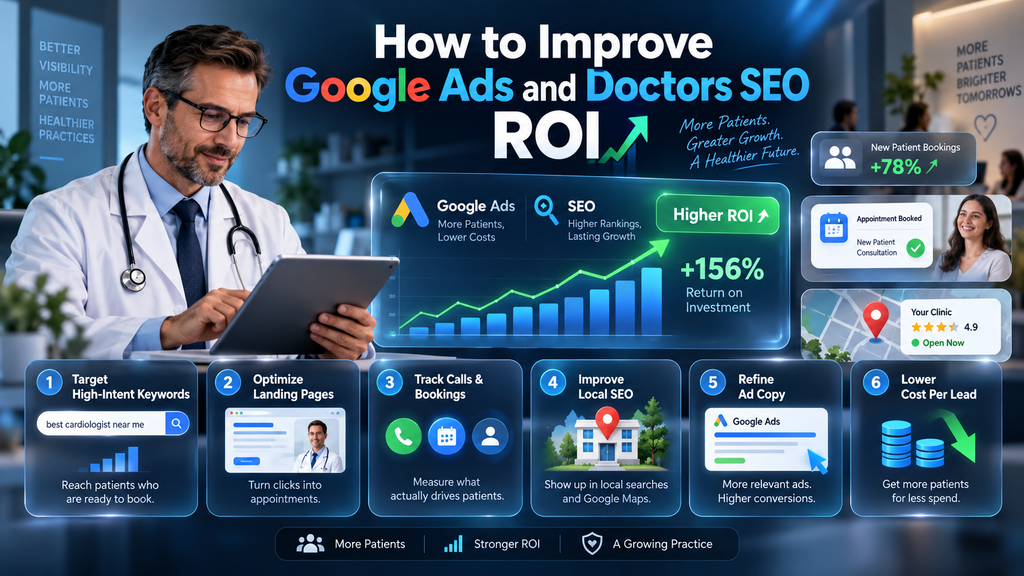
How to Improve Google Ads and Doctors SEO ROI
Improving ROI begins with focusing on qualified patients rather than simply increasing traffic.
Doctors should identify their most valuable medical services and create dedicated campaigns around them.
Each campaign should have relevant keywords, ad copy, and landing pages.
SEO teams can then optimize those landing pages and create supporting content.
For example:
A clinic advertises “hair loss treatment.”
The ad sends visitors to a dedicated hair loss service page.
SEO optimization targets related organic keywords.
Supporting blog content answers common hair loss questions.
Internal links connect those articles to the main treatment page.
Over time, the website can generate traffic from both paid advertisements and organic search.
This creates a stronger search ecosystem.
Build a Sustainable Search Strategy
Google Ads can provide fast results, but relying entirely on paid advertising can become expensive.
SEO can reduce this dependency by gradually increasing organic traffic.
A practical strategy may look like this:
Use Google Ads to capture immediate high-intent searches.
Identify the keywords that generate quality patient inquiries.
Build SEO pages around the strongest topics.
Create supporting informational content.
Optimize local search visibility.
Improve technical SEO and website performance.
Track conversions from both paid and organic traffic.
Gradually strengthen organic visibility while continuing paid campaigns where they remain profitable.
This approach can create both short-term and long-term growth.
Conclusion
Google Ads for doctors and SEO should not be viewed as completely separate marketing strategies.
Google Ads can help medical practices generate immediate visibility and test valuable patient search terms.
SEO can use those insights to build long-term organic rankings, local authority, and sustainable search traffic.
When doctors combine paid search with strong SEO, they can increase search visibility, reach patients at different stages of their journey, improve landing pages, generate more qualified inquiries, and reduce long-term dependence on paid traffic.
The most effective strategy is to use Google Ads for immediate patient acquisition while continuously building a strong Doctors SEO foundation for long-term growth.
Frequently Asked Questions
Is Google Ads good for doctors?
Google Ads can help doctors reach people who are actively searching for relevant medical services and can be useful for generating appointment inquiries quickly.
Why is SEO important for doctors?
SEO helps medical practices improve organic visibility, rank for relevant healthcare searches, attract local patients, and build sustainable search traffic.
Should doctors use Google Ads and SEO together?
Yes. Google Ads can provide immediate visibility while SEO builds long-term organic growth. Using both can create stronger search coverage.
Can Google Ads keywords help with doctors SEO?
Yes. Paid campaign data can show which search terms generate clicks and conversions. Doctors can use these insights when planning organic SEO pages and content.
Which is better for doctors, Google Ads or SEO?
Neither is universally better. Google Ads is useful for faster results, while SEO is stronger for long-term organic visibility. A combined approach is often more effective.



Leave a Reply