
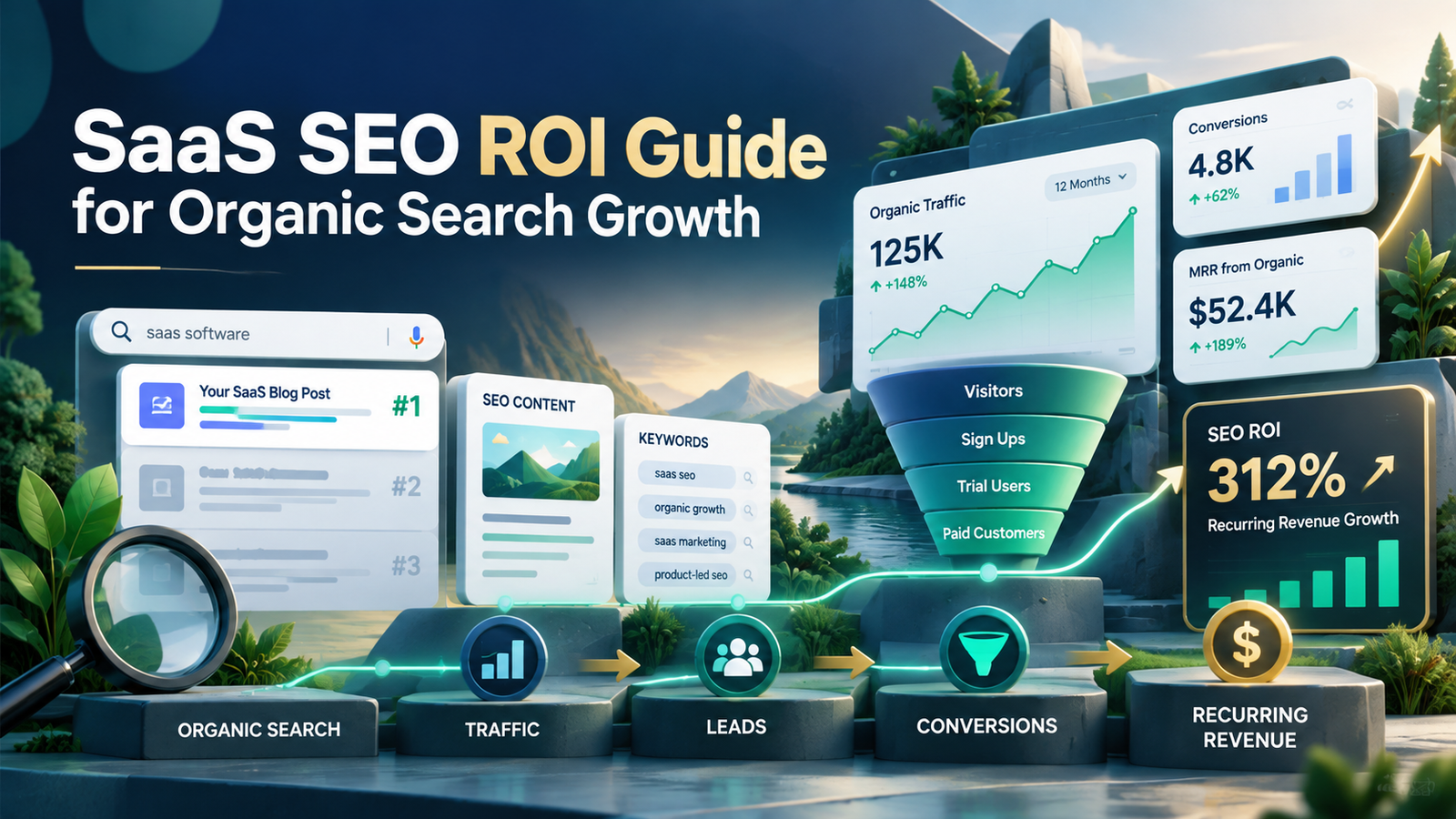

For SaaS companies, SEO is more than just a way to increase website traffic. A strong organic search strategy can attract qualified prospects, generate free-trial sign-ups, support demo requests, and contribute to recurring revenue over time. Measuring SaaS SEO ROI helps businesses understand whether their SEO investment is generating real financial value and supporting sustainable growth.
This is where SaaS SEO ROI becomes important.
Calculating SEO return on investment helps SaaS companies compare the value generated from organic search with the money and resources invested in SEO. Instead of focusing only on rankings and traffic, SaaS teams can connect SEO performance with leads, conversions, customer acquisition, and revenue.
Measuring SEO ROI can be more complex than tracking paid advertising because organic search often influences customers across several stages of the buying journey. Still, with the right metrics, tracking setup, and formulas, SaaS companies can build a clearer picture of the business value created by SEO.
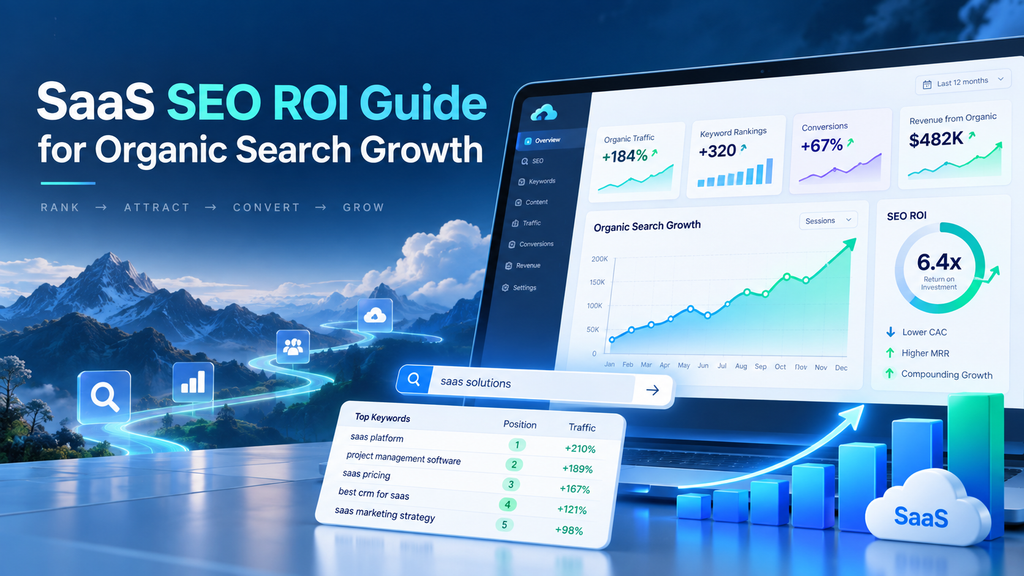
What Is SaaS SEO ROI?
SaaS SEO ROI measures the financial return a software company receives from its investment in search engine optimization.
It compares the revenue or estimated business value generated by organic search with the total cost of SEO activities.
The basic formula is:
SEO ROI = (SEO Revenue − SEO Cost) ÷ SEO Cost × 100
For example, if a SaaS company spends $10,000 on SEO and generates $30,000 in revenue attributed to organic search, the calculation would be:
($30,000 − $10,000) ÷ $10,000 × 100 = 200% ROI
This means the company generated a return equal to twice its original SEO investment after accounting for the SEO cost.
However, SaaS SEO ROI should not always be evaluated using immediate revenue alone. Organic search can also contribute to product discovery, lead generation, customer education, and long-term brand visibility.
Why Measuring SaaS SEO ROI Matters
Tracking SEO ROI helps SaaS companies understand whether their SEO strategy is supporting business growth.
Many SEO reports focus heavily on traffic, impressions, and keyword rankings. These metrics are useful, but executives and business owners usually want to understand how marketing activities contribute to revenue.
Calculating SaaS SEO ROI allows teams to answer important questions such as:
- Is organic search generating qualified leads?
- Which landing pages produce the most valuable conversions?
- Which SEO topics contribute to customer acquisition?
- Is SEO becoming more cost-effective over time?
- Which parts of the SEO strategy deserve additional investment?
By connecting search performance to business outcomes, companies can make better marketing decisions.
Step 1: Calculate Your Total SEO Investment
Before calculating SaaS SEO ROI, you need to understand how much your business is spending on SEO.
SEO costs can include internal and external expenses.
Common costs may include:
- SEO agency fees
- SEO consultant fees
- Content writers
- Editors
- SEO software subscriptions
- Keyword research tools
- Technical SEO tools
- Link-building campaigns
- Website developers
- Graphic designers
- Internal SEO team salaries
- Content promotion expenses
For example, suppose your monthly SEO expenses include:
SEO specialist: $2,000
Content creation: $1,500
SEO tools: $500
Technical support: $1,000
Your total monthly SEO investment would be:
$5,000
This amount becomes the cost component of your ROI calculation.
Step 2: Track Organic Search Conversions
The next step is identifying which actions from organic visitors have business value.
For SaaS companies, conversions may include:
- Free-trial registrations
- Demo requests
- Paid subscriptions
- Contact form submissions
- Product sign-ups
- Newsletter subscriptions
- Software downloads
- Account registrations
Not every conversion has the same financial value.
A newsletter subscription may represent early interest, while a paid subscription creates direct revenue.
SaaS companies should therefore assign different values to different conversion types when possible.
Step 3: Identify Organic Search Revenue
If your analytics and CRM systems can connect customers with their original acquisition source, you can calculate revenue generated from organic search.
For example, imagine your SaaS website receives 50 paying customers from organic traffic during one month.
If the average first-year revenue per customer is $1,200, then:
50 customers × $1,200 = $60,000 organic revenue
This value can then be used in the SaaS SEO ROI formula.
If your SEO investment for the same period was $15,000:
($60,000 − $15,000) ÷ $15,000 × 100 = 300% SEO ROI
This provides a clearer financial view of SEO performance.
Step 4: Calculate the Value of Organic Leads
Not every SaaS website allows visitors to purchase immediately.
Many B2B SaaS businesses use demo requests or sales conversations before customers subscribe.
In this case, you can estimate organic search value by assigning an expected financial value to each qualified lead.
A simple formula is:
Lead Value = Average Customer Value × Lead-to-Customer Conversion Rate
For example:
Average customer value = $5,000
Lead-to-customer conversion rate = 10%
$5,000 × 10% = $500 estimated lead value
If organic search generates 100 qualified leads:
100 × $500 = $50,000 estimated organic search value
This method helps SaaS companies evaluate SEO even when users do not purchase directly through the website.
Step 5: Use Customer Lifetime Value
For SaaS businesses, customer lifetime value can be especially important when calculating SEO ROI.
Because SaaS companies often generate recurring monthly or annual revenue, a customer may continue producing revenue long after the original acquisition.
Customer Lifetime Value, often shortened to CLV or LTV, estimates the total amount of revenue a customer may generate throughout the relationship with the company.
A simple example:
Average monthly revenue per customer = $100
Average customer lifetime = 24 months
Customer Lifetime Value = $100 × 24 = $2,400
If organic search brings in 40 customers:
40 × $2,400 = $96,000 potential lifetime revenue
Using lifetime value can provide a more complete understanding of SEO’s long-term impact.
However, companies should use realistic assumptions based on their actual customer retention data.
Step 6: Measure Organic Conversion Rate
Organic traffic alone does not determine the financial success of SEO.
SaaS companies should also monitor how effectively organic visitors convert.
The formula is:
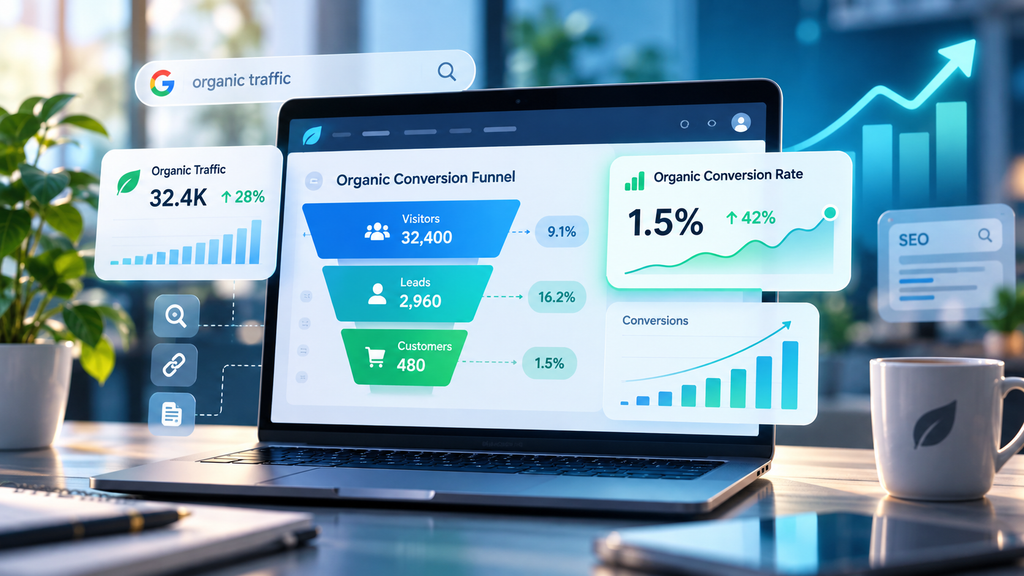
Organic Conversion Rate = Organic Conversions ÷ Organic Visitors × 100
Suppose your website receives 10,000 organic visitors and generates 300 free-trial sign-ups.
The conversion rate would be:
300 ÷ 10,000 × 100 = 3%
If your organic traffic continues growing while the conversion rate declines, your SEO strategy may be attracting users with weaker buying intent.
This is why traffic quality matters just as much as traffic volume.
Step 7: Track Revenue by Landing Page
One of the best ways to measure organic search value is to analyze the performance of individual landing pages.
Different pages often contribute very different levels of business value.
For example, a blog article may generate significant traffic but only a few conversions.
A comparison page or product feature page may receive less traffic but generate more demo requests.
SaaS companies should evaluate landing pages based on:
- Organic traffic
- Conversion rate
- Number of leads
- Trial registrations
- Demo requests
- Revenue generated
- Assisted conversions
This helps identify which SEO pages contribute most strongly to business growth.
Step 8: Measure Branded and Non-Branded Organic Traffic
Branded search traffic comes from people already searching for your company or product name.
Non-branded traffic comes from searches related to problems, topics, and solutions without mentioning your brand.
For SaaS companies, non-branded organic growth can be particularly valuable because it indicates that the company is reaching potential customers who may not already know about the product.
For example, someone searching for:
“best project management software”
may represent a new potential customer.
Tracking branded and non-branded traffic separately provides a better understanding of how SEO contributes to market discovery.
Step 9: Measure Assisted Conversions
SEO does not always receive credit for the final sale.
A potential customer may discover your SaaS brand through an organic blog post, return later through social media, and eventually sign up after clicking a paid advertisement.
If you only look at the final interaction, SEO may appear less valuable than it actually was.
Assisted conversion analysis helps show how organic search contributed to the customer journey before the final conversion.
SaaS companies should therefore consider both direct conversions and assisted conversions when evaluating organic search value.
Step 10: Calculate Cost per Organic Lead
Cost per organic lead can help SaaS companies compare SEO efficiency with other acquisition channels.
The formula is:
Cost per Organic Lead = Total SEO Investment ÷ Organic Leads Generated
For example:
Monthly SEO investment = $10,000
Organic leads = 200
$10,000 ÷ 200 = $50 per organic lead
You can compare this number with the cost per lead generated from paid search, social media advertising, or other marketing channels.
Over time, SEO may become more efficient because well-performing content can continue generating leads after the initial publishing cost.
Step 11: Calculate Organic Customer Acquisition Cost
Customer acquisition cost, commonly called CAC, shows how much a company spends to acquire a paying customer.
For SEO, the calculation can be:
Organic CAC = Total SEO Investment ÷ Customers Acquired Through Organic Search
For example:
SEO investment = $20,000
Organic customers = 80
$20,000 ÷ 80 = $250 organic CAC
This metric becomes more useful when compared with customer lifetime value.
If organic CAC is $250 and average customer lifetime value is $3,000, organic search may represent an attractive acquisition channel.
SaaS SEO ROI Example
Consider a SaaS company spending $12,000 per month on SEO.
During the same period, organic search generates:
150 qualified leads
30 new customers
Average customer value = $2,000
The estimated organic revenue would be:
30 × $2,000 = $60,000
Now calculate SEO ROI:
($60,000 − $12,000) ÷ $12,000 × 100
The result is:
400% SEO ROI
This means the value attributed to organic search exceeded the SEO investment by four times after subtracting costs.
The example is simplified, but it demonstrates how SaaS companies can connect SEO activity with financial results.
Important Metrics for Measuring SaaS SEO Value
SaaS SEO ROI should be supported by several additional metrics.
Organic Traffic
Organic traffic measures how many people reach your website through unpaid search results.
Traffic growth can help demonstrate increasing visibility.
Organic Conversions
Organic conversions show how many visitors complete important actions such as trials, demos, or sign-ups.
Conversion Rate
Conversion rate shows how effectively organic traffic turns into business outcomes.
Customer Acquisition Cost
Organic CAC helps measure the efficiency of SEO as a customer acquisition channel.
Customer Lifetime Value
LTV helps SaaS companies understand the long-term revenue value of customers acquired through SEO.
Keyword Visibility
Growing keyword visibility can indicate that your website is gaining authority and reaching more potential customers.
Non-Branded Organic Traffic
This shows whether SEO is helping your brand reach people who were not previously searching for your company.
Revenue from Organic Search
Organic revenue provides the clearest connection between SEO performance and business results when reliable attribution data is available.
How Long Does It Take to Generate Positive SaaS SEO ROI?
SEO is usually a long-term acquisition strategy.
Unlike paid advertising, SEO does not necessarily generate immediate results after a page is published.
New SaaS websites may need time to build topical authority, earn backlinks, improve search visibility, and establish trust with search engines.
The time required varies depending on factors such as:
- Website authority
- Competition
- Content quality
- Technical SEO
- Keyword difficulty
- Backlink profile
- Existing organic visibility
For this reason, SaaS companies should evaluate SEO ROI over meaningful periods rather than reacting to short-term changes.
Monthly reporting can monitor progress, while quarterly and annual analysis can provide a clearer picture of long-term ROI.
How Organic Search Creates Long-Term Value
One of the major advantages of SEO is that optimized pages can continue generating traffic after they are published.
Paid advertising generally stops producing traffic when ad spending stops.
SEO content, however, can continue attracting users for months or even years if the content remains relevant and competitive.
This means the value of a successful SEO page may continue increasing long after its original creation cost.
For SaaS companies, this can improve acquisition efficiency over time.
How to Improve SaaS SEO ROI
Improving SEO ROI requires more than simply publishing more content.
SaaS companies should focus on activities that contribute to qualified traffic and conversions.
Start by identifying pages already receiving organic visibility.
Improve pages ranking near the first page of search results.
Update older content that has started losing traffic.
Create commercial content targeting high-intent searches.
Strengthen internal linking between informational and product pages.
Improve calls to action across high-traffic content.
Optimize landing pages for conversion.
Build relevant backlinks to strategically important pages.
Fix technical SEO issues that prevent valuable pages from being indexed or ranked properly.
These improvements can increase both organic traffic quality and conversion performance.

Common Mistakes When Calculating SaaS SEO ROI
One common mistake is measuring SEO solely through traffic.
More traffic does not automatically mean more revenue.
Another mistake is ignoring the value of assisted conversions.
Organic search may introduce customers to your company even if another channel receives credit for the final conversion.
Companies may also overestimate SEO ROI by assigning unrealistic revenue values to leads.
Use actual sales and customer data whenever possible.
Another mistake is ignoring internal SEO costs.
Team salaries, content production, software, technical resources, and external services should all be included when calculating the total investment.
Tools for Measuring SaaS SEO ROI
Several platforms can help SaaS companies measure organic search performance.
Google Search Console can provide data about impressions, clicks, queries, rankings, and landing page visibility.
Google Analytics can help track website traffic, user behavior, events, and conversions.
Customer relationship management systems can connect leads with sales outcomes.
SEO platforms can provide additional data about keyword rankings, backlinks, competitors, and technical performance.
The most useful setup connects search data, analytics, conversion tracking, and revenue information.
Build a SaaS SEO ROI Dashboard
A dedicated SEO dashboard can make reporting easier.
A useful SaaS SEO dashboard may include:
- Organic sessions
- Organic conversions
- Demo requests
- Trial registrations
- Qualified leads
- Paying customers
- Organic revenue
- SEO investment
- Cost per organic lead
- Organic CAC
- Customer lifetime value
- Organic conversion rate
- Keyword visibility
- Non-branded organic traffic
The dashboard should focus on metrics that support business decisions rather than showing unnecessary data.
Final Thoughts
Calculating SaaS SEO ROI helps companies move beyond simple metrics such as traffic and rankings.
By connecting organic search performance with conversions, leads, customer acquisition, recurring revenue, and lifetime value, SaaS teams can better understand how SEO contributes to business growth.
The basic ROI formula provides a useful starting point, but a complete analysis should also consider customer lifetime value, organic CAC, assisted conversions, lead value, and conversion rates.
The most effective SaaS SEO strategies combine strong search visibility with measurable business outcomes.
When companies consistently track SEO investment and organic search value, they can identify their most profitable pages, improve weak areas, and allocate resources toward strategies that support sustainable long-term growth.
Frequently Asked Questions
What Is SaaS SEO ROI?
SaaS SEO ROI measures the financial value generated from search engine optimization compared with the total amount invested in SEO activities.
How Do You Calculate SaaS SEO ROI?
A basic formula is:
SEO ROI = (SEO Revenue − SEO Cost) ÷ SEO Cost × 100
This formula compares organic search revenue with the cost of SEO.
What Costs Should Be Included in SEO ROI?
Include expenses such as SEO staff, agencies, content creation, software tools, developers, link building, and other resources directly involved in your SEO strategy.
How Can SaaS Companies Measure Organic Search Value?
SaaS companies can measure organic search value through revenue, qualified leads, free trials, demo requests, customer lifetime value, organic CAC, and conversion rates.
Should Customer Lifetime Value Be Used in SaaS SEO ROI?
Customer lifetime value can provide additional context because SaaS businesses often generate recurring revenue. However, businesses should use realistic lifetime value estimates based on actual customer data.
What Is a Good Organic Conversion Rate for SaaS?
There is no universal conversion rate that applies to every SaaS business. Conversion performance varies depending on traffic intent, product type, pricing, audience, and the conversion being measured.
Can SEO ROI Be Negative?
Yes. SEO ROI may be negative during early stages if SEO costs are higher than measurable revenue. This does not automatically mean the strategy has failed, especially if visibility and qualified traffic are still developing.
How Often Should SaaS SEO ROI Be Measured?
Teams can monitor performance monthly, but quarterly and annual reviews are often more useful for understanding long-term SEO value and growth patterns.




Leave a Reply