

Choosing between free vs paid SaaS SEO tools can be challenging, especially when your goal is to improve search rankings, attract qualified visitors, and grow a SaaS business without wasting your marketing budget. Free SEO tools can provide valuable insights for keyword research, website performance, indexing, and basic optimization, while paid tools generally offer deeper data, competitive research, automation, and advanced reporting.
The right choice depends on your website size, SEO goals, available budget, and the complexity of your strategy. A new SaaS website may be able to achieve meaningful progress with a carefully selected free SEO toolkit. However, as the website grows and competition increases, premium features can save time and provide insights that are difficult to obtain manually.
This guide compares free and paid SaaS SEO tools, explains their benefits and limitations, and helps you determine which approach best matches your SaaS SEO strategy.
What Are SaaS SEO Tools?
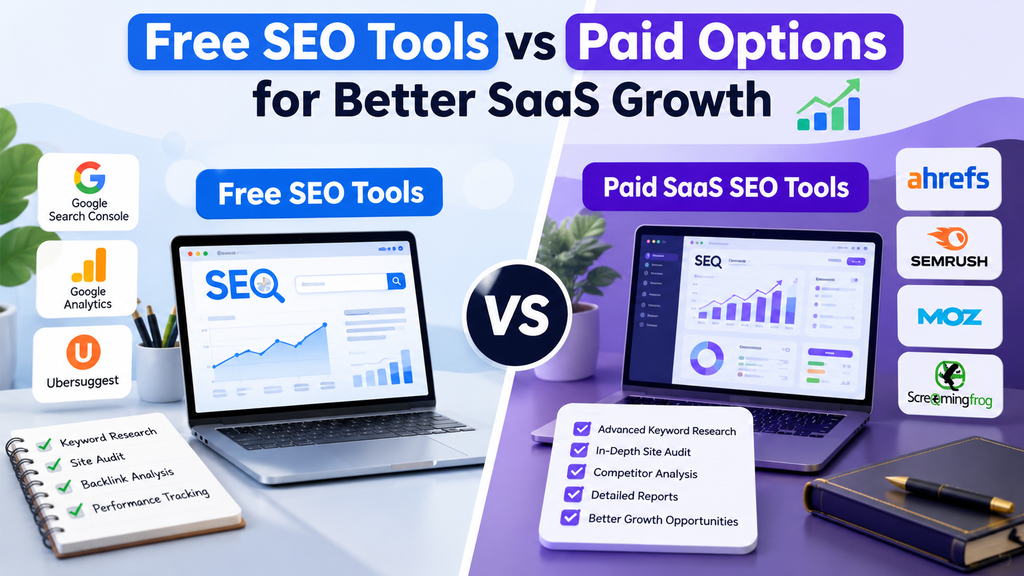
SaaS SEO tools are software platforms and online resources that help businesses research, monitor, analyze, and improve their search engine optimization efforts. They can support different areas of SEO, including keyword research, technical audits, content optimization, backlink analysis, competitor research, rank tracking, and performance measurement.
For SaaS companies, these tools can be particularly useful because organic search often supports long-term customer acquisition. Instead of relying entirely on paid advertising, a SaaS company can create useful content and optimized product or service pages that continue attracting relevant search traffic over time.
The challenge is deciding how much SEO software your business actually needs.
Understanding Free SaaS SEO Tools
Free SEO tools provide essential features without requiring a recurring subscription. Some platforms are completely free, while others offer limited versions of premium products.
Free tools are particularly useful for startups, small SaaS websites, individual marketers, and businesses beginning their SEO journey.
They can help you understand how search engines interact with your website, identify basic optimization opportunities, monitor organic performance, and research content ideas.
For example, website owners can use free resources to monitor search visibility, discover technical problems, evaluate page performance, and understand visitor behavior.
Benefits of Free SaaS SEO Tools
One of the biggest advantages of free tools is obvious: cost efficiency.
A startup may not have enough marketing budget to invest in several premium SEO platforms. Free tools allow the company to begin collecting valuable information while keeping expenses under control.
They are also excellent for learning SEO. Beginners can understand important concepts such as impressions, clicks, keywords, indexing, backlinks, and technical performance before moving to more advanced software.
Another benefit is simplicity. Free tools often focus on a smaller number of functions, which can make them easier to understand.
For a new SaaS website with relatively few pages, that may be enough.
Limitations of Free SEO Tools
Free does not necessarily mean ineffective, but free software often comes with restrictions.
A tool may limit the number of keyword searches, reports, projects, crawled pages, competitor analyses, or historical records available to users.
Data depth can also be limited. A SaaS company operating in a competitive market may need detailed information about competitor keywords, backlinks, ranking changes, and content gaps. Free platforms may not provide enough information to support this level of analysis.
Another limitation is workflow efficiency.
If your SEO team has to collect information manually from several different platforms, tasks that could take minutes with an integrated premium platform may require considerably more time.
Therefore, the real cost of free SEO tools is not always zero. Your business should also consider the time required to collect, organize, and interpret the information.
What Are Paid SaaS SEO Tools?
Paid SaaS SEO tools are subscription-based platforms that generally provide broader datasets, advanced features, higher usage limits, and more sophisticated reporting capabilities.
Depending on the platform, premium SEO software can combine several functions in one dashboard, including:
- Keyword research
- Competitor analysis
- Backlink research
- Site auditing
- Rank tracking
- Content research
- Keyword gap analysis
- Reporting and monitoring
- Historical SEO data
- Team collaboration features
For growing SaaS companies, having these capabilities available in one platform can make SEO campaigns easier to manage.
Advantages of Paid SaaS SEO Tools
1. Advanced Keyword Research
Keyword research becomes more complicated as your SaaS business grows.
You may need to evaluate hundreds or thousands of search terms according to search volume, intent, competition, relevance, and business value.
Premium SEO platforms usually provide more extensive keyword databases and filtering capabilities. This makes it easier to build structured keyword strategies instead of selecting topics based only on individual search terms.
2. Better Competitor Research
Competitor analysis is another major advantage of premium SEO tools.
Instead of manually checking individual competitor pages, advanced platforms can help identify keywords competitors rank for, their strongest pages, backlink opportunities, and potential content gaps.
These insights can help your SaaS team understand the competitive search landscape and identify areas worth investigating.
3. Detailed Backlink Analysis
Backlinks can play an important role in building the authority and visibility of a website.
Free tools may provide limited backlink information, while paid platforms often offer larger databases and more detailed filtering options.
You can evaluate referring domains, discover new links, identify lost links, study competitor backlink profiles, and research potential link-building opportunities.
4. Comprehensive Site Audits
Technical SEO problems can prevent otherwise useful content from performing effectively.
Paid site-auditing tools can crawl large numbers of pages and highlight problems involving internal links, metadata, duplicate content, crawlability, redirects, broken links, and other technical elements.
For a small SaaS website, manual checks may be manageable. For a website containing hundreds or thousands of URLs, automated auditing becomes significantly more valuable.
5. Rank Tracking
Search rankings can change over time.
Premium rank-tracking features allow teams to monitor selected keywords regularly and examine how visibility changes across different pages, devices, or locations where supported.
This can help SaaS marketers determine whether optimization work is producing measurable search improvements.
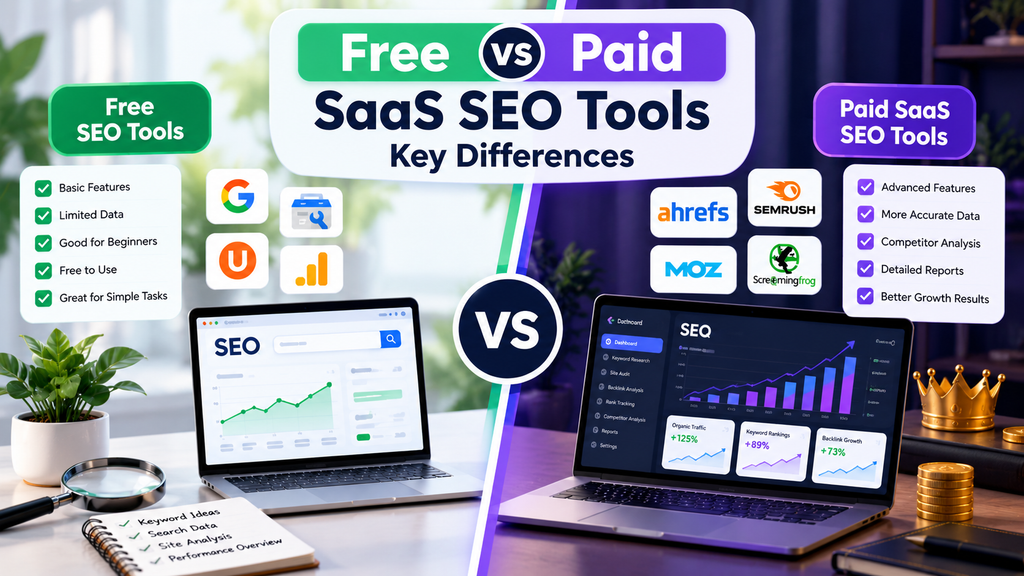
Free vs Paid SaaS SEO Tools: Key Differences
The biggest difference between free and paid SEO tools is not simply price. It is the depth, scale, and efficiency of the information available.
| Feature | Free SEO Tools | Paid SEO Tools |
|---|---|---|
| Cost | Free or limited | Monthly/annual subscription |
| Keyword Research | Basic to moderate | More advanced |
| Competitor Analysis | Usually limited | Detailed |
| Backlink Research | Limited datasets | Larger datasets and filters |
| Site Audits | Basic or restricted | More comprehensive |
| Rank Tracking | Limited | Advanced monitoring |
| Historical Data | Often restricted | Commonly available |
| Reporting | Basic | Advanced/customizable |
| Large Websites | Less convenient | Better suited |
| Team Workflows | Limited | Often supported |
Free platforms can be highly valuable when you need core information. Paid platforms become more useful when you need to process larger datasets, research competitors regularly, or manage SEO across many pages.
When Should You Use Free SaaS SEO Tools?
Free SEO tools are often suitable when you are launching a new SaaS website or operating with a limited marketing budget.
They can also work well when your primary goals include checking indexing, measuring organic clicks, finding basic keyword ideas, monitoring website performance, or fixing straightforward technical issues.
If you only manage a small number of pages, purchasing an expensive platform immediately may not be necessary.
Instead, build a strong SEO foundation first.
Create helpful content, optimize important landing pages, establish logical internal linking, improve technical performance, and monitor results. Once your SEO operations become more complex, you can determine which premium capabilities would actually improve your workflow.
When Are Paid SaaS SEO Tools Worth It?
Paid SEO tools become more attractive when SEO is an important customer acquisition channel for your SaaS business.
For example, imagine your website has hundreds of blog posts and landing pages. Your team is targeting competitive commercial keywords while monitoring several competitors and running an active link-building campaign.
Collecting all that information manually can become inefficient.
In this situation, premium software may save substantial research time and provide centralized data for decision-making.
A paid platform can also make sense when multiple people are working on SEO and need consistent reports, projects, keyword lists, or monitoring.
The important point is to purchase a tool because its features solve a specific problem—not simply because it is popular.
Can You Combine Free and Paid SEO Tools?
Yes. In many cases, a hybrid SEO toolkit is more practical than choosing exclusively between free and paid options.
A SaaS company can use free platforms for essential first-party search and website information while using one premium platform for advanced keyword research, competitor analysis, backlinks, or rank tracking.
This approach can reduce unnecessary subscriptions.
Instead of purchasing several platforms with overlapping features, identify what information you already receive for free and then invest only where there is a meaningful gap.
How to Choose the Right SaaS SEO Tools
Before choosing an SEO platform, start with your objectives.
Ask what your team actually needs to accomplish. Do you need better keyword research? Are technical issues your biggest challenge? Do you need to understand competitor strategies? Are you struggling to monitor rankings or backlinks?
Once the problem is clear, compare tools according to the features that directly address it.
You should also consider usability. A platform with hundreds of advanced features offers little value if your team does not understand or regularly use them.
Scalability matters as well. A solution that works for a 20-page SaaS website may become inefficient once the site grows to thousands of pages.
Finally, consider return on investment rather than subscription price alone.
A paid tool that saves hours of repetitive work or helps uncover valuable opportunities may justify its cost. On the other hand, an expensive platform that remains largely unused is simply another business expense.
Free vs Paid SaaS SEO Tools for Startups
For early-stage SaaS startups, beginning with free tools is often practical.
At this stage, the priority should usually be establishing the fundamentals of search optimization. Make sure important pages can be discovered, create content around relevant user needs, optimize titles and headings, build useful internal links, and monitor organic search performance.
As traffic and content production increase, your requirements will become clearer.
You may discover that competitor research is consuming too much time or that you need better keyword data. That is a stronger reason to upgrade than purchasing premium software before your SEO process is established.
Free vs Paid SEO Tools for Growing SaaS Companies
Growing SaaS businesses typically have more complex requirements.
They may operate multiple content clusters, optimize product and feature pages, target different stages of the customer journey, monitor many competitors, and track hundreds of keywords.
At this level, advanced SEO platforms can improve efficiency.
Automation can reduce repetitive tasks, while deeper datasets can make research more systematic. Teams can spend less time gathering information and more time interpreting it and implementing improvements.
However, premium software should support a clear SEO strategy rather than replace one.
Common Mistakes When Selecting SaaS SEO Tools
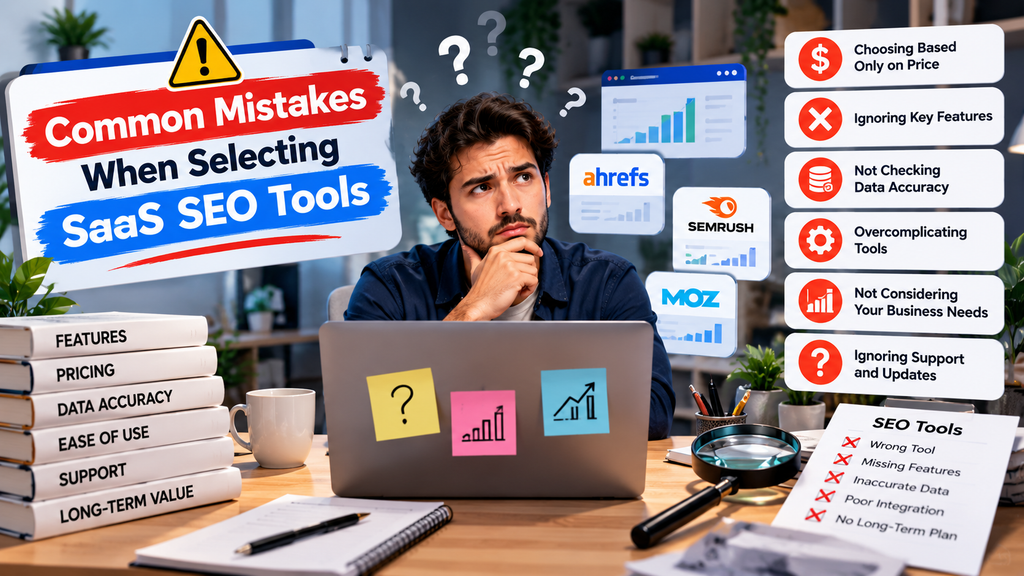
A common mistake is subscribing to too many tools.
SEO platforms frequently provide overlapping functionality. Paying for several products that perform similar tasks can increase costs without significantly improving results.
Another mistake is choosing tools based solely on the number of features.
More features do not automatically create more value. The best platform is one that addresses the specific requirements of your website and workflow.
SaaS teams should also avoid relying entirely on tool-generated scores or recommendations. SEO tools provide data and identify potential issues, but human analysis is still necessary to determine priorities, understand search intent, and create content that genuinely helps users.
Final Thoughts on Free vs Paid SaaS SEO Tools
The free vs paid SaaS SEO tools decision depends on your business stage, budget, website size, competition, and SEO objectives.
Free tools can provide an excellent foundation for startups and smaller websites. They allow businesses to monitor search performance, understand website health, and begin optimizing content without adding another recurring expense.
Paid tools become increasingly valuable as SEO operations grow more complex. Advanced keyword databases, competitor intelligence, backlink analysis, site auditing, rank tracking, historical data, and automated reporting can make large-scale SEO campaigns easier to manage.
For many SaaS businesses, the most efficient solution is a combination of both. Use free tools where they provide sufficient information and invest in premium platforms only when advanced capabilities can clearly improve your research, workflow, or decision-making.
The tool itself does not create sustainable organic growth. A strong SaaS SEO strategy, useful content, technical optimization, consistent measurement, and informed execution are what turn SEO data into meaningful results.
Frequently Asked Questions
Are free SEO tools enough for a SaaS website?
Free tools can be enough for a new or relatively small SaaS website, especially for basic performance monitoring, indexing analysis, keyword research, and technical checks. Larger or highly competitive websites may eventually benefit from more advanced capabilities.
Are paid SaaS SEO tools worth the cost?
They can be worth the cost when their features save significant time, provide information your current toolkit cannot supply, or support larger and more complex SEO campaigns. Their value depends on how effectively the business uses the data.
Should a SaaS startup pay for SEO software?
Not necessarily at the beginning. A startup can establish its SEO foundation using free resources and upgrade when specific limitations begin affecting research, monitoring, or productivity.
Can I use free and paid SEO tools together?
Yes. Combining free tools with a carefully selected premium platform can provide strong coverage while reducing unnecessary subscription costs.
What features should I look for in a SaaS SEO tool?
Useful features can include keyword research, technical site auditing, competitor analysis, backlink research, rank tracking, content research, reporting, and integrations. The most important features depend on your individual SEO goals.
How many SEO tools does a SaaS business need?
There is no fixed number. Instead of collecting many tools, choose a small set that covers your core requirements without unnecessary feature overlap.



Leave a Reply