

B2B SaaS SEO is a long-term marketing approach. It helps software companies show up more in search results. It helps them reach the right business audiences. Additionally, it helps them attract high-quality organic traffic. These advantages grow over time as trust and authority build, resulting in lasting impact across different industries.
Unlike traditional SEO, SaaS SEO often targets buyers through a longer journey. This journey runs from spotting a business problem to researching, comparing, and choosing software. Such paths require patience and measurement as teams adjust tactics and align with product road-maps and buyer needs.
An effective <strong>B2B SaaS SEO strategy</strong> uses several key steps.It includes keyword research and understanding search intent.It also focuses on creating high-quality content.It needs technical fixes and strong internal links.It tracks performance to measure results. The right <strong>SaaS SEO tools</strong> can make this work easier. They help you find keyword chances, spot technical issues, review search results, and track growth.
This guide explains how B2B SaaS SEO works and why it matters. It also covers tools that support your strategy. You will learn how content and interactive tools can work together. This helps build steady organic growth.
What Is B2B SaaS SEO?
B2B SaaS SEO improves a software website for other businesses. It helps the site appear more often in relevant search results.
The primary objective is not simply to increase website visits. A successful strategy focuses on attracting people and businesses whose needs align with the SaaS product.
For example, a project management SaaS company might create content around searches such as:
- What is project management software?
- How can teams manage remote projects?
- Best project management tools for businesses
- Project management software for agencies
- How to improve team productivity
These searches represent different stages of the customer journey. B2B SaaS SEO connects relevant keywords with the right content and pages for each stage.

Why Is B2B SaaS SEO Important for Organic Growth?
B2B buyers often research problems and potential solutions before contacting a company or starting a software trial. Search engines can therefore become an important discovery channel for saas seo.
A strong SaaS SEO strategy can help a business:
- increase relevant organic search visibility;
- attract potential customers throughout the buying journey;
- build topical authority around its software category;
- support product, feature, and solution pages;
- generate qualified organic traffic;
- reduce dependence on paid traffic over time; and
- connect content performance with leads and conversions.
The key is relevance.Large amounts of unrelated traffic are not very helpful.A smaller audience can be more valuable.They are looking for problems the product can solve.
How Does B2B SaaS SEO Work?
Successful B2B SaaS SEO usually involves several connected processes rather than one optimization technique.
1. SaaS Keyword Research
SaaS keyword research identifies the words and questions potential customers use when searching online.
Keywords can generally be mapped to different stages of the buying journey.
Informational searches might include:
- what is customer churn;
- how to calculate customer acquisition cost; or
- how to improve customer retention.
Commercial searches can include:
- best CRM software for small businesses;
- SaaS analytics tools; or
- project management software for agencies.
Understanding these differences helps businesses create content that matches what users actually want.
2. Search Intent Analysis
Search intent describes the purpose behind a search.
A user asking “What is SaaS churn?” probably wants an explanation. Someone searching for “SaaS churn calculator” is more likely looking for an interactive tool.
Those keywords are closely related, but they should not necessarily lead to identical experiences.
Matching content with search intent helps create pages that answer the actual query rather than simply repeating a target keyword.
3. SaaS Content Optimization
Content should answer the main query clearly while also providing enough supporting information to make the page genuinely useful.
A SaaS content strategy may include:
- educational guides;
- how-to articles;
- comparison content;
- product and feature pages;
- industry-specific resources;
- templates;
- checklists;
- calculators; and
- interactive SEO tools.
These content types can then be organized into topic clusters.
4. Technical SEO for SaaS Websites
Technical SEO for SaaS focuses on making important pages accessible and understandable to search engines while maintaining a strong user experience.
Important areas include:
- website crawl-ability;
- indexing;
- XML sitemaps;
- robots.text directives;
- canonical URLs;
- redirects;
- broken links;
- mobile usability;
- website architecture; and
- page performance.
Technical SEO becomes increasingly important as a SaaS website grows and adds product pages, integrations, documentation, tools, and hundreds of informational resources.
Which Tools Can Help With B2B SaaS SEO?
Different tools solve different SEO problems. A business does not necessarily need every available platform. The goal is to select tools that support specific parts of the SEO workflow.

1. Search Performance Tools
Search performance tools help SaaS businesses understand how their pages perform in organic search.
They can provide information about:
- search queries;
- impressions;
- clicks;
- landing pages;
- indexing;
- crawl-related issues; and
- search visibility.
Google Search Console, for example, can help website owners understand how Google discovers and displays their pages.
This information can reveal existing opportunities. A page receiving significant impressions but relatively few visits may deserve further analysis of its title, search intent, content, or snippet.
2. SaaS Keyword Research Tools
A SaaS keyword research tool helps discover topics potential customers are searching for.
Useful keyword research features can include:
- keyword discovery;
- related searches;
- long-tail keyword ideas;
- competitor keyword research;
- search intent analysis;
- keyword grouping; and
- topic discovery.
However, keyword selection should not depend on search volume alone.
A highly specific B2B SaaS keyword with lower search demand can still be valuable when the people searching for it closely match the company’s target audience.
3. Keyword Intent Checkers
A keyword intent checker helps determine the likely purpose behind a search.
Keywords may be grouped into categories such as informational, navigational, commercial, or transactional.
For example:
“What is CRM software?” → informational intent
“Best CRM for agencies” → commercial investigation
“CRM software pricing” → stronger commercial or transactional intent
Understanding intent helps determine whether a keyword needs an article, comparison page, product page, or interactive resource.
4. Keyword Clustering Tools
A keyword clustering tool organizes closely related keywords into logical groups.
Instead of creating separate articles for every small keyword variation, SaaS businesses can build stronger pages around broader topics.
For example, keywords such as:
- SaaS customer churn;
- SaaS churn rate;
- how to calculate churn;
- customer churn formula; and
- churn rate calculation
may belong within the same topic cluster.
This approach can simplify content planning while reducing unnecessary overlap between pages.
5. SERP Preview and Metadata Tools
SEO titles and meta descriptions help communicate the purpose of a page in search results.
A SERP preview tool allows content creators to preview how a title and description may appear in a search-style layout.
Related tools can include:
- SEO title checkers;
- title length analyzers;
- meta description checkers; and
- snippet preview tools.
These tools can help with consistency, but titles should always be written for clarity and relevance rather than simply reaching a particular character count.
6. Technical SEO Tools
Technical SEO tools help identify problems that may affect crawling, indexing, or website performance.
They can be used to examine:
- broken links;
- redirect chains;
- indexability;
- duplicate pages;
- canonical tags;
- sitemap issues;
- robots directives; and
- website performance.
Regular technical reviews are particularly valuable for SaaS websites that frequently add new pages and functionality.
7. Robots.text Generators and Checkers
A robots.text file provides instructions to compliant crawlers about which areas of a website they may crawl.
A robots.text generator can help create directives, while a checker can help review existing rules.
These tools should be used carefully because an incorrect rule may prevent important website sections from being crawled.
Important public pages should not be intentionally blocked when the goal is for search engines to discover them.
8. XML Sitemap Checkers
An XML sitemap can help search engines discover important URLs.
An XML sitemap checker can help identify basic issues with a sitemap and its URLs.
SaaS websites should generally ensure that their sitemap focuses on important canonical URLs intended for search discovery rather than filling it with unnecessary or low-value URLs.
A sitemap can support discovery, but its presence alone does not guarantee that every page will be indexed.
9. Canonical URL Tools
SaaS websites can sometimes produce multiple URLs containing similar content.
Canonical tags help indicate the preferred version of a page.
A canonical tag generator or checker can assist with implementation, but canonicalization should reflect the actual website structure rather than being applied automatically without understanding the affected URLs.
SaaS Calculators That Can Support SEO Content
B2B SaaS websites can also provide business calculators alongside traditional SEO tools.
Useful examples include:
SaaS MRR Calculator
A Monthly Recurring Revenue calculator can help users measure recurring monthly subscription revenue.
An informational article explaining what MRR is can naturally link to the calculator for visitors who want to calculate their own figures.
SaaS ARR Calculator
An ARR calculator can help estimate Annual Recurring Revenue.
This can complement educational content explaining ARR, recurring revenue, and the differences between MRR and ARR.
SaaS CAC Calculator
Customer Acquisition Cost measures the cost associated with acquiring customers.
A CAC calculator can turn an informational guide into an interactive experience by allowing readers to apply the formula to their own numbers.
SaaS LTV Calculator
Customer Lifetime Value estimates the value a customer may generate during their relationship with a business.
LTV-related articles can link to an LTV calculator and related CAC resources.
SaaS Churn Rate Calculator
Churn is an important metric for subscription businesses.
A churn calculator can complement content about customer retention, revenue churn, and SaaS growth metrics.
How to Connect SaaS SEO Content With Tools
One effective content strategy is to connect informational pages with tools that help users take action.
For example:
What Is SaaS MRR? → MRR Calculator → MRR vs ARR Guide → ARR Calculator
A customer acquisition cluster could follow:
What Is SaaS CAC? → CAC Calculator → CAC vs LTV Guide → LTV Calculator
An SEO keyword cluster might include:
SaaS Keyword Research Guide → Keyword Intent Checker → Keyword Clustering Guide → Keyword Cluster Generator
This creates meaningful internal-linking opportunities while helping visitors move from learning about a topic to using a relevant resource.
How to Build an Effective B2B SaaS SEO Strategy
Start by understanding your target audience and the business problems your software solves.
Next, perform keyword research and separate keywords by topic and search intent. Build core topic clusters instead of publishing unrelated articles.
Create high-quality pages that answer specific questions thoroughly and connect them with relevant tools, supporting guides, and commercial pages.
Technical SEO should then ensure that important content can be crawled and discovered correctly.
Finally, measure performance and improve pages based on real data rather than assumptions.
An effective workflow can look like:
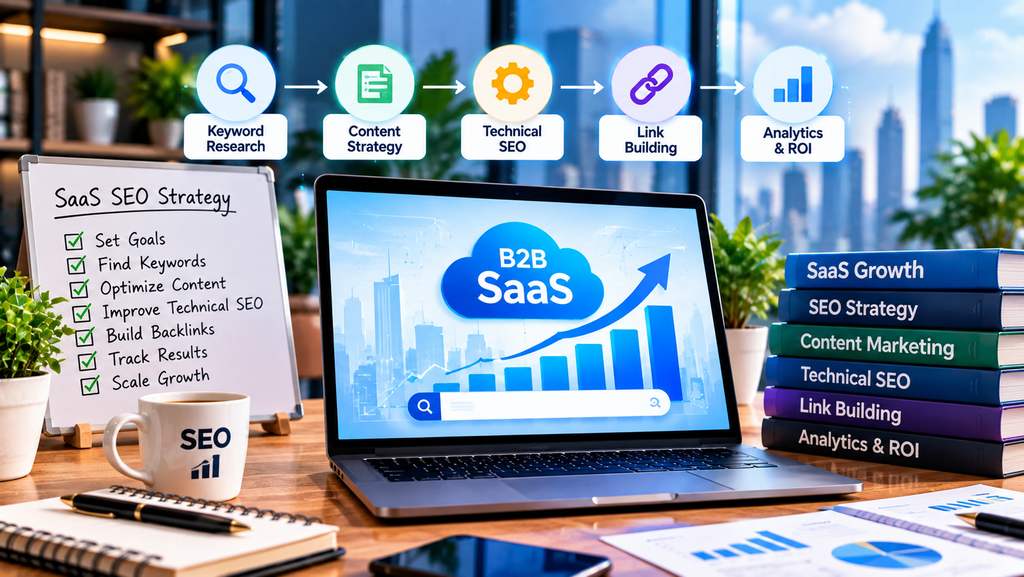
Research → Create → Optimize → Internally Link → Measure → Update
SEO is an ongoing process, especially in competitive SaaS markets.
Common B2B SaaS SEO Mistakes to Avoid
Even a well-designed website can struggle when its SEO strategy has structural problems.
Common mistakes include:
Targeting Keywords Only by Search Volume
Search volume does not automatically equal business value. Keywords should also be evaluated for relevance and intent.
Publishing Overlapping Content
Creating multiple articles targeting nearly identical searches can make the site unnecessarily complicated. Build clear topic clusters and assign a primary purpose to each URL.
Ignoring Internal Links
Relevant internal links help visitors discover supporting information and connect related resources across the website.
Creating Tools Without Supporting Content
A calculator or checker can be useful on its own, but supporting explanations, examples, FAQs, and related guides can make the overall resource more helpful.
Ignoring Technical SEO
Crawling and indexing issues can limit the visibility of otherwise valuable content.
Focusing Only on Rankings
Rankings are only one measurement. SaaS businesses should also evaluate relevant organic traffic, engagement, leads, signups, and conversions where appropriate.
Frequently Asked Questions About B2B SaaS SEO
What does B2B SaaS SEO mean?
B2B SaaS SEO is the process of improving organic search visibility for SaaS companies.These companies sell products or services to other businesses.
Which tools are useful for SaaS SEO?
Useful tools include search performance platforms and keyword research tools.They also include keyword intent checkers and clustering tools.Other helpful tools include SERP preview tools and technical SEO analyzers.You can also use sitemap checkers and tools for specific SEO tasks.
Can SaaS calculators support an SEO strategy?
Yes. Relevant calculators can complement informational content by allowing users to apply formulas or concepts directly. Examples include MRR, ARR, CAC, LTV, churn rate, and SEO ROI calculators.
What is the difference between a SaaS SEO article and an SEO tool?
An informational article primarily explains a topic or answers a question. An SEO tool performs a specific task, such as calculating a metric, checking metadata, or generating an output. Connecting the two can create a more useful experience.
How long does B2B SaaS SEO take to work?
There is no universal timeframe. Results can vary based on competition, website condition, content quality, technical implementation, authority, and the keywords being targeted. SEO should generally be treated as an ongoing growth strategy rather than an immediate traffic source.
Final Thoughts on B2B SaaS SEO and SEO Tools
B2B SaaS SEO combines search strategy, helpful content, technical fixes, keyword research, internal links, and measurement.
It helps SaaS businesses improve organic visibility.
SEO tools make these tasks easier to research and manage.
SaaS calculators and interactive resources can add more value for visitors.
The best approach connects both sides of the website.
Informational content should help visitors understand a problem.
Relevant tools should help them analyze, calculate, check, or solve it.