

Building a successful B2B SaaS SEO strategy requires more than publishing a few blog posts.
Additionally, it also needs adding keywords to website pages.
Moreover, SaaS companies often compete in busy markets.
Thus, potential customers research solutions, compare platforms, read reviews, explore features, and review pricing before deciding.
Consequently, a well-planned SEO strategy helps your business appear throughout this research process and attract potential customers through organic search.
The right SEO tools can make this process more efficient. They help SaaS businesses discover valuable keywords, understand search intent, analyze competitors, identify technical problems, optimize content, monitor backlinks, and measure organic performance.
However, tools alone cannot produce sustainable growth. The strongest results come from combining reliable SEO data with useful content, a technically sound website, and a strategy based on the needs of your target audience.
This guide explains how to build a B2B SaaS SEO strategy using the right tools and how each part of the process can contribute to long-term organic visibility.
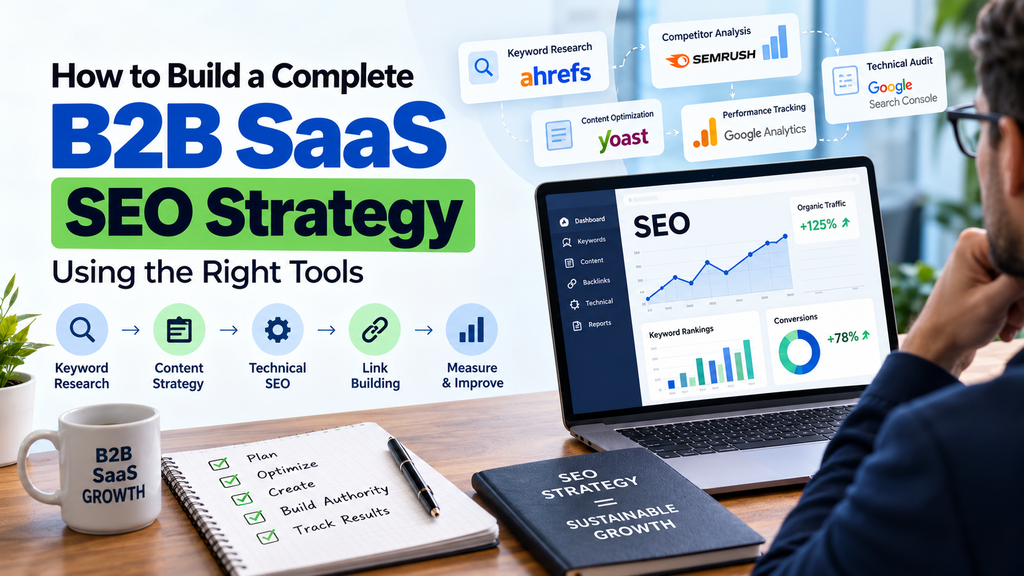
What Is a B2B SaaS SEO Strategy?
A B2B SaaS SEO strategy is a structured approach to improving the organic search visibility of a software-as-a-service company that sells products or solutions to other businesses.
Unlike some consumer purchases, B2B software decisions can involve a longer research process. A potential customer may search for educational information first, investigate different solutions later, compare features and alternatives, and finally visit product or pricing pages.
An effective SaaS SEO strategy therefore needs to target multiple stages of the customer journey.
For example, a SaaS company might create informational content for users searching questions such as “how to improve team productivity,” comparison content for people evaluating software options, and optimized product pages for visitors already interested in a specific solution.
SEO tools help identify these opportunities and provide data that can guide each stage of the strategy.
Why Is SEO Important for B2B SaaS Companies?
SEO can become a sustainable customer acquisition channel for B2B SaaS businesses because potential buyers frequently use search engines during the research and evaluation process.
Paid advertising can generate visibility quickly, but traffic usually declines when advertising spending stops. SEO works differently. A useful article, landing page, feature page, or comparison page can continue attracting relevant organic visitors after it has been published and indexed.
A strong B2B SaaS SEO strategy can help a company:
- Increase organic search visibility
- Reach potential customers during product research
- Generate qualified website traffic
- Build topical authority
- Improve brand awareness
- Support lead-generation efforts
- Reduce dependence on paid acquisition channels
- Create sustainable long-term organic growth
The objective should not simply be generating more traffic. SaaS SEO should attract visitors whose problems, needs, and search intent align with the software being offered.
1. Define Your B2B SaaS SEO Goals
Before choosing keywords or creating content, define what SEO needs to achieve for your SaaS business.
Different companies may have different priorities. A newer SaaS website might initially focus on increasing visibility and building topical authority, while an established company may focus more heavily on product-led organic traffic, demo requests, trials, or qualified leads.
Common SaaS SEO goals include increasing:
- Organic traffic
- Keyword visibility
- Non-branded search impressions
- Product and feature page traffic
- Free-trial registrations
- Demo requests
- Qualified leads
- Organic conversions
Clear goals make it easier to select useful metrics and determine which SEO tools are actually necessary.
2. Use SEO Tools for Keyword Research
Keyword research is one of the foundations of a successful B2B SaaS SEO strategy.
Instead of targeting keywords purely because they have high search volume, focus on queries that are relevant to your software, audience, and business objectives.
SEO platforms such as Ahrefs, Semrush, Moz, and Google Keyword Planner can help uncover keyword ideas and evaluate factors such as estimated search demand, competition, related queries, and keyword variations.
For SaaS websites, useful keyword groups can include:
Informational keywords: Queries used by people researching a problem or learning about a topic.
Commercial keywords: Searches that indicate users are comparing solutions or investigating products.
Product-related keywords: Terms directly connected with the software’s features, integrations, use cases, or capabilities.
Alternative and comparison keywords: Queries involving software comparisons, alternatives, and competing solutions.
Organizing keywords according to search intent makes it easier to create the right type of page for each query.
3. Understand Search Intent Before Creating Content
Finding a keyword is only the beginning. You also need to understand why someone searches for it.
Search intent generally falls into categories such as informational, navigational, commercial, and transactional intent.
For example, someone searching “what is CRM automation?” probably wants educational information. A user searching “best CRM automation software for small businesses” is likely evaluating solutions.
Review the pages already appearing in search results for your target keyword. Look at their content format, depth, angle, and purpose.
This helps determine whether your keyword should be targeted with a blog article, comparison page, feature page, use-case page, landing page, or another content format.
Matching content with search intent can improve both relevance and user experience.
4. Analyze Your SaaS Competitors
Competitor research can reveal valuable SEO opportunities.
Tools such as Semrush and Ahrefs can help analyze which keywords competing websites rank for, which pages attract organic traffic, and which websites link to their content.
Instead of simply copying competitor keywords, use this information to identify gaps.
Ask questions such as:
What topics are competitors covering successfully?
Which relevant topics have they ignored?
Can your company provide more current information?
Can you explain a difficult topic more clearly?
Are there important product use cases competitors have not covered properly?
This approach turns competitor analysis into an opportunity-finding process rather than a copying exercise.
5. Build Topic Clusters Around SaaS Expertise
Publishing unrelated articles can make it difficult to develop strong topical relevance. A better approach is to organize content into topic clusters.
A topic cluster normally includes a broad pillar page supported by several more specific articles.
For example, a B2B SaaS SEO cluster could contain:
Pillar topic: B2B SaaS SEO
Supporting topics: SaaS keyword research, SaaS technical SEO, SaaS content strategy, SaaS link building, SEO tools for SaaS companies, SaaS competitor analysis, and SaaS SEO metrics.
These supporting pages can internally link to the main pillar page and to other relevant articles.
A logical content structure also makes it easier for visitors to discover related information and for search engines to understand relationships between pages.
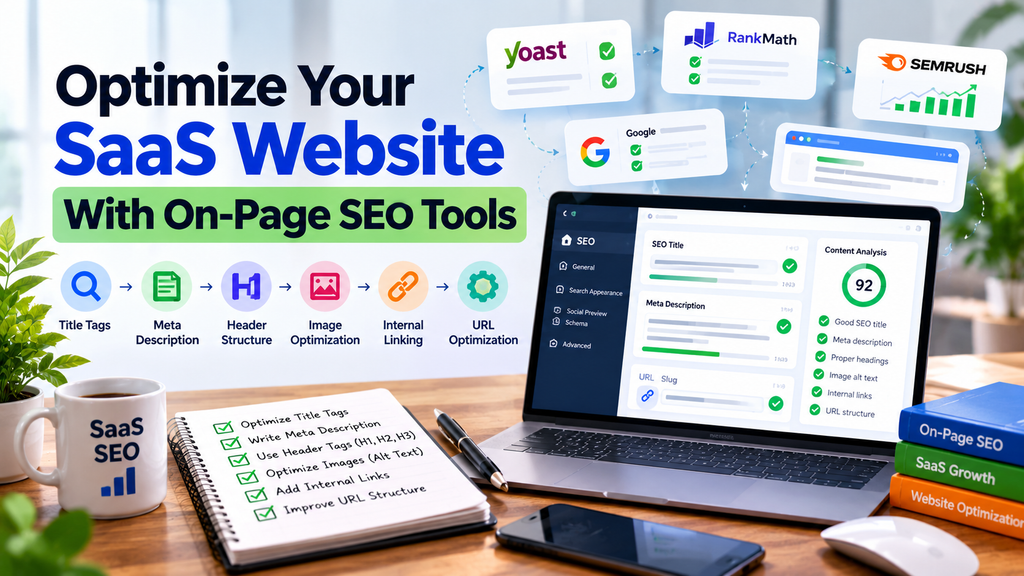
6. Optimize Your SaaS Website With On-Page SEO Tools
Once content is created, on-page optimization helps search engines and users understand the page.
Tools such as Yoast SEO or Rank Math can assist WordPress users with basic optimization checks. However, plugin scores should be treated as guidance rather than the primary goal.
Important on-page elements include:
- SEO-friendly title tags
- Clear H1 headings
- Logical H2 and H3 structure
- Descriptive URLs
- Relevant internal links
- Useful image alt text
- Natural keyword placement
- Compelling meta descriptions
- Readable paragraphs
- Relevant supporting terminology
The primary keyword should appear naturally in important locations without being repeated excessively.
Content should always be written for people first. Optimization should improve clarity and relevance rather than make the article sound artificial.
7. Perform a Technical SEO Audit
Even excellent SaaS content may struggle if search engines cannot efficiently discover, crawl, render, or index the website.
Technical SEO tools such as Google Search Console, Screaming Frog, PageSpeed Insights, and Site Audit platforms can help identify potential problems.
Check important technical elements such as:
Indexability: Confirm that important pages are eligible for indexing.
Crawlability: Ensure search engines can reach important website sections.
Robots directives: Check that valuable content is not unintentionally blocked.
XML sitemap: Maintain an accurate sitemap containing canonical, indexable pages.
Canonical tags: Reduce confusion around duplicate or similar URLs.
Broken links: Repair internal links that lead to missing pages.
Mobile usability: Make sure important content works properly across screen sizes.
Page performance: Identify unnecessary performance bottlenecks.
Technical audits should be conducted periodically, especially after redesigns, migrations, major plugin changes, or significant website expansion.
8. Create Helpful SaaS Content
Content is central to most B2B SaaS SEO strategies, but publishing large amounts of generic material is not enough.
Create content that directly addresses real customer problems and questions.
Useful SaaS content formats include:
- How-to guides
- Educational articles
- Product tutorials
- Feature explanations
- Industry guides
- Comparison pages
- Alternative pages
- Integration guides
- Use-case pages
- Original research
- Case studies
Whenever possible, demonstrate genuine product or industry knowledge. Screenshots, examples, workflows, original data, expert explanations, and practical recommendations can make content more valuable than generic summaries.
Each article should have a clear purpose within the broader customer journey.
9. Build a Strategic Internal Linking Structure
Internal linking connects related pages across your SaaS website.
For example, an article about SaaS keyword research could link to a broader B2B SaaS SEO guide, a relevant SEO tool page, and another article explaining search intent.
Internal links can help users discover useful related information while helping search engines understand website structure.
Use descriptive anchor text that accurately represents the destination page rather than repeatedly using generic phrases such as “click here.”
Also review older articles whenever new content is published. Relevant links from established pages can strengthen connections throughout your content library.
10. Earn Relevant Backlinks
Backlinks remain an important part of building online authority, particularly in competitive SaaS markets.
Tools such as Ahrefs, Semrush, and Moz can help analyze backlink profiles and identify potential outreach opportunities.
Rather than chasing large quantities of low-quality links, focus on earning relevant links from trustworthy websites.
Link-worthy SaaS assets can include original research, statistics, free tools, templates, detailed tutorials, industry reports, and genuinely useful resources.
Digital PR, partnerships, expert contributions, and targeted outreach can also support natural link acquisition.
Quality and relevance should take priority over raw backlink numbers.
11. Measure SEO Performance With the Right Tools
SEO needs continuous measurement.
Google Search Console can provide information about search queries, impressions, clicks, indexing, and page performance in Google Search. Google Analytics can help you understand website behavior and conversions, while third-party SEO platforms can provide additional keyword and competitor data.
Important SaaS SEO metrics can include:
- Organic clicks
- Search impressions
- Organic conversions
- Non-branded visibility
- Indexed pages
- Landing-page performance
- Trial registrations
- Demo requests
- Qualified leads
- Backlink growth
Avoid judging success from rankings alone. A keyword ranking is more valuable when it contributes relevant traffic and meaningful business outcomes.
12. Continuously Improve Your B2B SaaS SEO Strategy
SEO is not a one-time project.
Search behavior changes, competitors publish new content, products evolve, and older articles can gradually become outdated.
Regularly review your highest-value pages. Update old statistics, improve weak sections, repair broken links, add relevant internal links, refresh examples, and expand content when new questions become important.
SEO tools can help identify declining pages and new opportunities, but strategic decisions should still be based on user needs and business relevance.
A continuous optimization process can help SaaS companies maintain and improve organic visibility over time.

Common B2B SaaS SEO Mistakes to Avoid
Several mistakes can weaken an otherwise strong strategy.
Avoid publishing content solely for search engines, targeting irrelevant high-volume keywords, creating multiple pages for nearly identical search intent, ignoring technical SEO problems, buying low-quality backlinks, and measuring performance only through rankings.
Another common problem is relying too heavily on SEO tools.
Tools provide valuable data, but they cannot fully understand your customers, product positioning, competitive advantages, or business priorities. Use SEO software to support decisions rather than replace strategic thinking.
Final Thoughts
Creating a successful B2B SaaS SEO strategy with the right tools involves keyword research, understanding search intent, providing helpful content, optimizing technical aspects, linking internally, building authority, and measuring performance regularly.
Start by defining clear business goals and understanding the problems your target audience is trying to solve. Use SEO tools to discover opportunities, analyze competitors, monitor technical health, and measure results. Then turn that information into useful pages that genuinely help potential customers throughout their research and buying journey.
The most effective SaaS SEO strategies are not built around one tool or one keyword. They develop through consistent optimization, strong website structure, relevant expertise, and content that connects search demand with genuine customer needs.
When these elements work together, SEO can become a sustainable channel for increasing organic visibility, attracting relevant prospects, and supporting long-term B2B SaaS growth.